
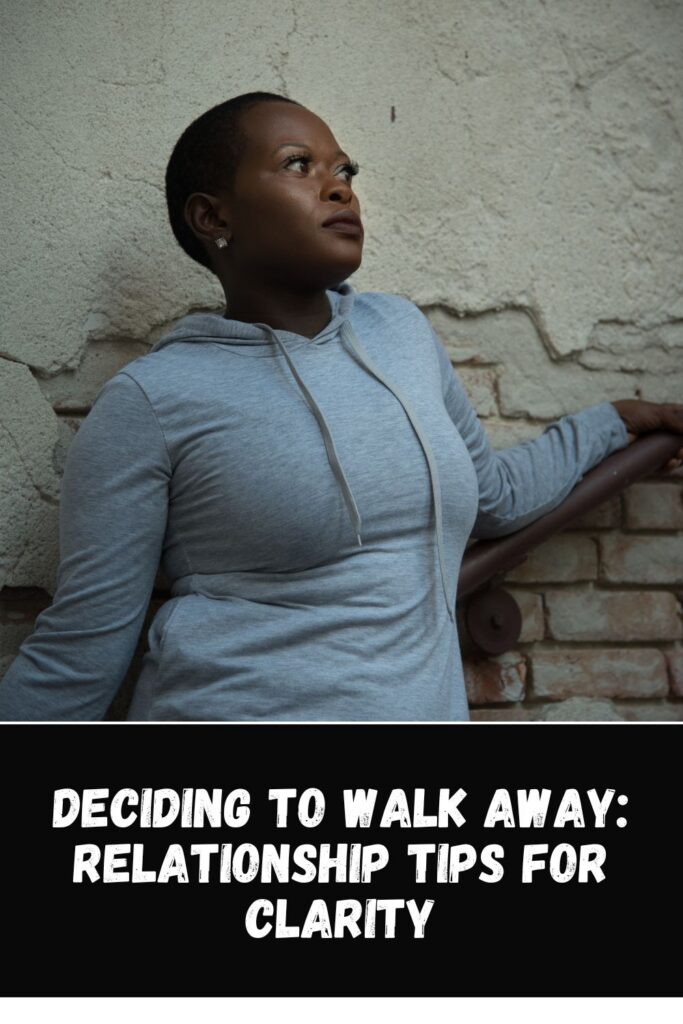
Deciding to Walk Away: Relationship Tips for Clarity




Stay or Walk Away? A Honest Guide to Knowing When a Relationship Has Run Its Course
| A Note Before We Begin: Community, Not Counseling Sherley’s Show is a community built to support women who are navigating some of the hardest seasons of their lives — including the painful uncertainty of not knowing whether to stay in or leave a relationship. This space exists so you do not have to walk through those moments alone. However, Sherley’s Show is not a substitute for licensed therapy, professional mental health counseling, or clinical guidance of any kind. I am not a licensed therapist, a mental health professional, or a counselor. All opinions shared here are my own, based on my personal life experiences. This community and therapy are not in competition with each other — they are meant to work side by side. If what you are experiencing goes beyond what a podcast episode or blog post can address, please do not hesitate to seek the support of a licensed professional. Therapy is not a sign of weakness. In fact, choosing therapy is one of the most courageous and self-respecting things you can do for yourself. For professional mental health resources and to find a licensed therapist, visit Psychology Today’s Therapist Finder at psychologytoday.com/us/therapists. Now, let’s have an honest conversation. |
One of the hardest places to be in life is standing at a crossroads in your relationship, not knowing whether the struggle you are experiencing is a temporary storm you can weather together or a signal that it is time to move on. The question “should I stay or go” is one that millions of people search for answers to every single day, and the truth is that no article, podcast episode, or well-meaning friend can make that decision for you. What we can do, though, is help you get clear on what you are actually feeling and why, so that the decision you ultimately make comes from a place of clarity rather than fear, confusion, or exhaustion.
Whether you are in a long-term marriage, a years-long partnership, or a relationship that has started to feel more like a habit than a choice, this post is for you. We are going to talk honestly about the signs that suggest it may be time to walk away, the signs that say this relationship is worth fighting for, and how to tell the difference between a rough patch and a genuine ending.
And before we go any further — if you have read our earlier post on the signs that it may be time to end a relationship, this is the natural next step in that conversation. Where that article helped you identify what you were feeling, this one is designed to help you figure out what to do about it.
Earlier Post: How To Know If The Relationship Is Over
Why This Question Is So Hard to Answer
If ending a relationship or staying in one were simple, there would not be an entire industry of therapists, relationship coaches, books, podcasts, and late-night conversations dedicated to helping people figure it out. The reason this decision is so difficult is that it sits at the intersection of emotion, history, identity, and fear — all at once.
Research published on Psychology Today notes that one of the biggest reasons people stay in relationships that are no longer serving them is the fear of being alone. Studies show that the fear of being single can actually cause people to lower their standards, overlook red flags, and tolerate dynamics that are actively harmful to their mental and emotional health. This is not a character flaw. It is a deeply human response to the idea of loss.
On the other side of that coin, many people leave relationships prematurely because they are reacting to a difficult season rather than a true incompatibility. Not every argument is a dealbreaker. Not every dry spell is the end of love. Not every season of distance means the connection is gone forever.
So how do you know which situation you are actually in? Let us break it down.
Signs It May Be Time to Leave
These are not meant to be a checklist that, if completed, gives you permission to walk away. Rather, they are indicators that deserve your serious, honest attention. If several of these resonate deeply with you, that is important information.
1. The Disrespect Is Consistent and Unaddressed
Every couple has moments of impatience, short tempers, or thoughtless words. That is a human reality. But there is a significant difference between a rough moment and a consistent pattern of disrespect. When you are regularly made to feel small, dismissed, humiliated, or controlled — and your concerns are met with denial, deflection, or further contempt — that is not a rough patch. That is a dynamic that will erode your sense of self over time.
Lack of respect is one of the clearest indicators that a relationship has moved beyond fixable tension into genuinely unhealthy territory. You deserve to be in a relationship where your voice is heard and your dignity is protected. If that baseline is consistently missing, your emotional and psychological safety must come first.
If you are in a situation involving any form of abuse — verbal, emotional, physical, or otherwise — please prioritize getting yourself safe. Reach out to someone you trust, and consider speaking with a professional who can help you create a safe plan forward.
Psychology Today: Why People Stay in Abusive Relationships
2. You Have Emotionally Checked Out
There is a trending relationship pattern being discussed widely right now sometimes referred to informally as “Banksying” — where one partner emotionally disconnects from the relationship entirely while continuing to physically remain in it. If you find that you have stopped caring about the outcomes of your arguments, stopped investing in shared experiences, and feel more like a roommate than a partner, that emotional disconnection is worth paying serious attention to.
Falling out of love is a gradual process. It does not usually happen overnight. But when the love that was once there has genuinely transformed into indifference — not frustration, not sadness, but actual emotional flatness — that is one of the more honest signals that something fundamental has shifted.
3. You Have Tried and the Patterns Have Not Changed
This one requires real honesty. Have you communicated your needs clearly and consistently? Have you both genuinely attempted to work through the core issues, whether independently, together, or with professional support? If the answer is yes — if you have had the conversations, made the efforts, and the same harmful patterns continue to repeat without any movement toward change — that is meaningful information.
Effort matters. But effort without change, repeated over a long enough period of time, is also data. You cannot want the relationship to be healthy more than your partner does.
4. You Envision Your Happiest Future Without Them In It
This is one of the more quietly honest tests you can give yourself. When you imagine the life you truly want — not out of anger, not in the middle of a fight, but in a calm, reflective moment — is your partner there? Or when you picture yourself at your most content, your most free, your most fully alive, is that image one where you are alone or with someone entirely different?
Daydreaming about single life occasionally is completely normal. But when the thought of being on your own brings you more relief than grief, and that feeling is steady and recurring, it is worth sitting with honestly.
5. Your Core Values Have Diverged in Ways That Cannot Coexist
People grow and evolve. That is not a betrayal — it is life. But sometimes two people grow in directions that are genuinely incompatible. When your foundational values around things like family, faith, finances, lifestyle, or your vision for the future no longer align — and neither of you is willing or able to bridge that gap — that is a real and valid reason to consider whether the relationship has run its natural course.
This is not about blame. It is about honesty. You can love someone deeply and still recognize that the two of you are no longer built for the same life.
| Important Reminder Recognizing signs that it may be time to leave does not mean you have failed. Some relationships serve an important chapter of your life and then reach their natural end. Acknowledging that is not giving up — it is being honest with yourself and with the person you are in relationship with. |
Signs It May Be Worth Fighting For
Now let us talk about the other side. Because not every struggle signals an ending. Some of the most meaningful, lasting relationships go through seasons that feel impossible — and come out the other side stronger for it. Here are the signs that what you are experiencing might be a rough patch rather than a genuine ending.
1. The Love Is Still There, Even When the Like Is Hard to Find
There is a meaningful difference between falling out of love and temporarily losing the ease of the relationship. If underneath the frustration, the distance, or the exhaustion, there is still a real and present love — if you still care deeply about this person’s wellbeing, their future, their happiness — that matters. It does not fix everything, but it is a foundation worth working from.
2. The Issues Are Circumstantial, Not Characterological
Sometimes couples go through brutal seasons because of external pressures — financial stress, job loss, grief, health crises, the demands of raising children, or the strain of major life transitions. These circumstances can create tension, disconnection, and conflict that has very little to do with who you are to each other at the core.
Ask yourself honestly: are we struggling because life is hard right now, or are we struggling because of who we fundamentally are to each other? If the answer is the former, that is something that time, support, and intentional effort can genuinely shift.
3. Both People Are Still Willing to Show Up
One of the clearest signs that a relationship is worth fighting for is that both people — even imperfectly, even inconsistently — are still trying. They are still showing up to the conversations, still expressing a desire to make it work, still willing to be vulnerable with each other. Mutual willingness is one of the most important ingredients in a relationship’s ability to survive and recover from difficult seasons.
If both of you want this, that is not nothing. In fact, that is everything.
4. You Have Not Yet Given It a Real, Honest Effort
This one requires you to be honest with yourself. Have you actually communicated your needs, or have you been hoping your partner would figure it out on their own? Have you suggested couples therapy, or has the idea felt too vulnerable to bring up? Have you had the hard conversation, or have you been avoiding it out of fear of what it might uncover?
Before you decide that a relationship is over, make sure you have genuinely given it the effort it deserves. Not for your partner’s sake alone — but for your own peace of mind. Years from now, you want to know that you gave it everything you had.
5. The Good Still Outweighs the Difficult
No relationship is perfect. Every long-term partnership will have seasons of difficulty, misunderstanding, and growth pains. But if, when you step back and look at the full picture, the love, the laughter, the friendship, the shared history, and the genuine partnership still outweigh the hard parts — that is a relationship worth investing in.
| Something Worth Considering Research consistently shows that couples therapy, when both partners are willing participants, can be genuinely transformative. Seeking therapy is not an admission that your relationship is broken beyond repair — it is a decision to bring in support so that you can communicate more effectively and understand each other more deeply. Find a licensed couples therapist near you: psychologytoday.com/us/therapists |
The Difference Between a Rough Patch and a Real Ending
One of the questions people ask most often is: how do I know if this is just a difficult season or if this is actually the end? Here is a framework to help you think through it:
| Rough Patch vs. Real Ending: A Simple Framework ROUGH PATCH — You may be in a rough patch if: • The core issues are tied to external circumstances (stress, loss, transition) • Both people still express love and a desire to make it work • The conflict is about behavior or communication, not about who the person fundamentally is • You can still access the friendship underneath the tension • Neither person has fully emotionally withdrawn REAL ENDING — It may be a genuine ending if: • The harmful patterns have continued despite repeated efforts to change them • One or both people have emotionally disengaged • Core values are fundamentally incompatible • There is consistent disrespect, contempt, or emotional safety concerns • You feel more relief than sadness when you imagine the relationship ending |
What to Do While You Are Still Figuring It Out
The in-between space — where you are not sure yet — is one of the most difficult places to exist. Here are some grounded steps you can take while you are still in that place of discernment:
- Get honest with yourself first. Before any conversation with your partner, spend real time understanding what you are feeling and why. Journaling, quiet reflection, or talking with a trusted friend can help you access your own clarity.
- Have the conversation you have been avoiding. Most people wait far too long to say what they actually need. Speak your truth to your partner, not in the middle of a fight, but in a calm moment where both of you can actually hear each other.
- Consider professional support. Couples therapy is not just for relationships in crisis. It is a tool for any two people who want to understand each other better and communicate more effectively. Individual therapy is equally valuable for helping you process your own feelings.
- Give the process time, but not indefinitely. There is a difference between giving your relationship a genuine chance and holding on out of fear. Set a mental timeline for yourself — not as an ultimatum, but as a compassionate boundary for your own wellbeing.
- Trust yourself. You know more about your relationship than any article, podcast, or outside opinion ever will. The answers you are looking for are already inside of you. Your job is to get quiet enough to hear them.
You Are Not Alone in This
Whatever you are going through right now, you do not have to navigate it in isolation. The conversations that feel too heavy to say out loud to the people closest to you — this is exactly the kind of space where they belong. Sherley’s Show was built for moments like this. For the women who are somewhere in the middle of a hard decision, who need to hear that what they are feeling is valid, that their confusion makes sense, and that their life is worth investing in — in whatever form that takes.
You are allowed to fight for your relationship. You are also allowed to walk away. What you are not allowed to do is disappear from yourself in the process.
| Key Takeaways • Knowing whether to stay or leave is one of the hardest decisions a person can face — and there is no universal answer. • Consistent disrespect, emotional disconnection, unchanged harmful patterns, and incompatible core values are meaningful signs that it may be time to go. • Still-present love, circumstantial struggles, mutual willingness to show up, and untested effort are signs the relationship may be worth fighting for. • The difference between a rough patch and a real ending often comes down to whether both people are still willing and able to grow toward each other. • Therapy is not a sign of weakness. It is one of the most self-respecting choices you can make in a difficult season. • You can hold space for both the community of Sherley’s Show and professional support at the same time — they are designed to work alongside each other. • Trust yourself. You already know more than you think you do. |
CONTINUE THE CONVERSATION ON SHERLEY’S SHOW
If this post resonated with you, the conversation does not have to stop here. Sherley’s Show covers topics like this one across three distinct formats — each offering a different perspective and depth of conversation:
| The Real Talk Series — with Sherley & Her Husband This is where things get real. Sherley and her husband sit down together to talk honestly about relationships, marriage, long-term partnership, and what it actually looks like to build a life with someone over decades. If you are navigating the stay-or-go question within a long-term committed relationship or marriage, this series is for you. Listen now at sherleysshow.com |
| Conversations — with Sherley & Kira Sherley and co-host Kira bring their unfiltered, real-life perspectives to some of the most difficult relationship experiences women face — including heartbreak, healing, infidelity, and the complicated feelings that do not fit neatly into any one category. If you are in the thick of it and need to hear from women who get it, start here. Listen now at sherleysshow.com |
| Interviews — Real Stories, Real Women, Real Healing The Interviews series on Sherley’s Show is where a wide range of voices get to be heard. Some guests are professionals — therapists, authors, and specialists who bring expertise and research to the conversation. But many are simply real women, everyday people, who have walked through something hard and made it to the other side. These are women who are willing to sit down and share their stories — their trauma, their turning points, their healing — not because they have a title or a credential, but because they know what it feels like to go through something alone and not want anyone else to feel that way. Sometimes the most powerful thing you can hear is not advice from a professional, but the honest voice of someone who has been exactly where you are. If you need to be reminded that you are not alone in what you are going through, the Interviews series is a great place to start. Listen now at sherleysshow.com |
| Find Sherley’s Show Everywhere You Listen Sherley’s Show is available on all major podcast platforms. Whether you are on your morning commute, taking a walk, or just need something real playing in the background, we are there. Explore all episodes, resources, and more at: sherleysshow.com You deserve a community that holds space for where you are — not just where you are going. We are glad you are here. |
Trauma to Profit — Coming Soon
Your story has power. And soon, there will be a dedicated space for women who are ready to stop surviving their experiences and start using them as fuel.
Trauma to Profit is coming. More information to follow. Stay connected at sherleysshow.com so you do not miss the announcement.
Additional Resources
If you are ready to explore professional support, Psychology Today offers a trusted, searchable directory of licensed therapists across the United States and internationally:
Find a Therapist — Psychology Today Therapist Finder
Understanding Why People Stay in Difficult Relationships — Psychology Today
The Fear of Being Alone and How It Affects Our Relationships — Psychology Today
Disclaimer: Sherley’s Show is a community platform and does not constitute licensed mental health, therapeutic, or professional counseling services. All content shared is based on personal experience and opinion. If you are experiencing a mental health crisis or are in an unsafe situation, please seek professional support immediately.
Sherley’s Show is learning and growing every single day. We aim to uplift all marginalized voices both on this podcast and in real life. Please note that we are always striving to change the problematic language that society has internalized in us. Thank you for your patience as we aim to strip certain phrases from our vocabulary.
Would you like to be a guest
Are you interested in getting your opinion out about a particular topic but don’t know how to do so? If so, here is an opportunity to do so to share your point of view, PLUS get your message and voice out there. It is always a great way to know about different perspectives and enrich ourselves through knowledge sharing.
Submit your relationship question.
Sherley’s Show provides an atmosphere where every woman is comfortable growing into their best self. Sherley’s Show is a no judgment podcast where we discuss how to rise strong out of all types of obstacles that come with relationships. Through personal life experiences and discussions ranging from infidelity, trust, forgiveness, sex, heartbreak, self love, therapy and more, we offer words of empowerment as you strive to build and maintain all of the relationships in your life. You may be going through something that is unique and difficult. Sharing your story gives others comfort and could also be helping someone else. Let them know they are not alone. Everyone has a story, do not let fear hold you back.
Disclosure: This post contains affiliate links, I will get a commission if you decide to make a purchase through any of my links, at no cost to you. Please read my disclosure for more info.

Want to launch a podcast?
FRee Resource!
Download Sherley’s FREE Bootcamp Podcast Launch Checklist! The no-fluff, step-by-step roadmap for busy women ready to finally launch the podcast they’ve been dreaming about.
At Sherley's Show, we believe that when women feel seen and supported, anything is possible. Whether you're tuning in for inspiration, education, or community—you belong here.



next

say goodbye to being the side chick
When you find yourself really settling with the reality that you are the side chick, when you find yourself tired of the games and/or the complacency, it’s time to ask yourself a few questions.
next

why is therapy important?
Solo therapy, partnered therapy, or group therapy... what exactly are the benefits? If you’re still on the fence about whether or not you should go and if therapy can really do anything for you... this post is for you.
next
CONNECT
elsewhere:

STAY AWHILE AND READ
THE BLOG

BINGE
THE PODCAST
The place where we chat about obstacles that come out of relationships and how to rise up from them. Self-love, marriage, infidelity, sex, heartbreak, and more.

HANG OUT ON

Comments +