
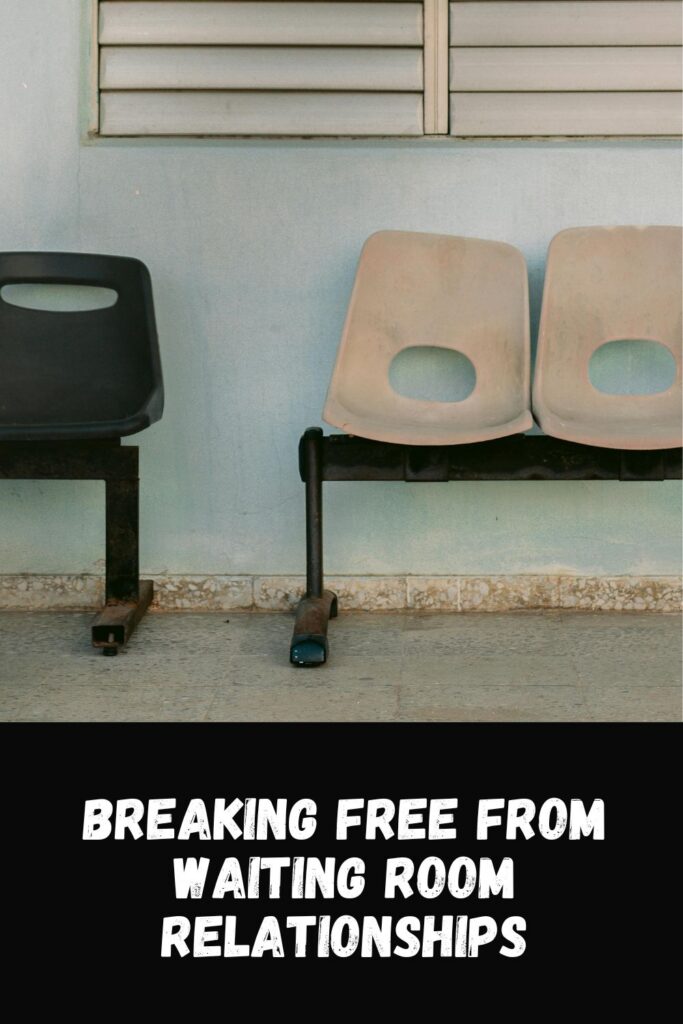
Breaking Free from Waiting Room Relationships




The Waiting Room Relationship: When ‘Almost’ Becomes a Full-Time Job
This content is shared for storytelling, educational, and entertainment purposes only and is not a substitute for professional counseling or therapy.
There is a specific kind of exhausted that comes from a relationship that never quite arrives. Not a bad relationship exactly — a waiting room. You are always just outside the actual thing, close enough to see it, never quite let in. Checking your phone has become a part-time job. Interpreting his moods has become a second one. And somewhere in the middle of all that unpaid labor, the years have started to add up.
What Makes a Relationship a Waiting Room
A waiting-room relationship has a specific signature: constant activity with almost no forward motion. There are dates, conversations, even moments of real closeness. What is missing is the thing that turns those moments into an actual relationship — a shared future named out loud, a public claim, a timeline that moves rather than resets. Six months in can look remarkably similar to two years in, which is itself the clearest evidence something is wrong.
It is worth being specific here, because ‘almost’ is easy to romanticize as patience or as a slow-burn love story. Slow relationships have forward motion, even if it is gradual. Waiting rooms have activity without motion — plenty happening, very little changing.
Why the Sunk Cost Keeps You There
The sunk cost fallacy is a well-documented cognitive bias where people continue investing in something specifically because they have already invested in it, regardless of whether the outcome looks promising. A 2021 study published in Personality and Social Psychology Review found that the more people invest in their relationships, the more dependent on their partners they come to feel — a dependency that has nothing to do with how good the relationship actually is (Forbes / Mark Travers). The years you have already put in do not become less wasted by adding more years to the pile. They compound.
Takeaway: Time already invested does not become less wasted by adding more time. The sunk cost only grows the longer the waiting room continues.
The Psychology of ‘I’m Not a Quitter’
One of the most powerful forces keeping women in waiting-room relationships is identity, not logic. When someone has built their self-image around being loyal, patient, or resilient, leaving can feel like betraying that identity rather than protecting it. As one clinician puts it, sometimes the hardest part of walking away isn’t losing the relationship — it’s losing the person you thought you were for staying (ReachLink). That identity was never actually at stake. Loyalty to a relationship that is not reciprocating it is not a virtue. It is a cost, dressed up as one.
The Explanations That Keep the Waiting Room Open
Waiting-room relationships survive on a very specific kind of explanation — always plausible, always slightly deferred. He’s dealing with a lot right now. He just needs a little more time. It’s not the right moment, but it will be soon. These explanations are not automatically dishonest. Circumstances genuinely do complicate timing sometimes. But notice the pattern: the resolution is always somewhere just ahead, never quite arriving, always requiring one more stretch of patience.
A useful check: compare the explanation given six months ago to the one being given now. If the substance is identical, only the calendar has changed, that is not context anymore. That is the actual, stable shape of the relationship.
What It Actually Costs You
The cost of a waiting room is rarely dramatic in any single moment, which is exactly what makes it so easy to underestimate. It is the friendships that thinned out because you kept your evenings open for someone who might text. It is the goals quietly shelved because your emotional bandwidth was mostly spent managing uncertainty. It is the version of you that might have met someone genuinely available, if you had not been holding a seat open for someone who was still deciding.
Psychologists studying sunk cost dynamics note that clinging to a relationship out of fear of ‘wasting’ the investment tends to drain time, happiness, and energy far more than the initial loss would have (Cleveland Clinic). The longer the waiting room stays open, the more expensive staying becomes, and the harder leaving starts to feel.
Takeaway: The cost of waiting rarely feels dramatic in any single moment — it accumulates quietly in friendships, goals, and other chances not taken.
The Difference Between Hope and Denial
Hope and denial can look identical from the inside, which is part of what makes waiting rooms so disorienting to sit inside of. Hope says: the evidence is mixed, so I will keep gathering more information before deciding. Denial says: the evidence is actually clear, but I am choosing not to look at it directly because looking would require acting. The test is not how you feel about the relationship. It is whether you could describe, honestly and specifically, what concrete change would need to happen, and by when, for you to consider the waiting over. If you cannot answer that question with real specificity, the waiting likely has no actual endpoint attached to it at all — it is simply the ongoing condition.
This is not a comfortable exercise, and it is not meant to be. It is meant to convert a feeling you have been carrying quietly for months into information you can actually act on.
What Other Women in This Position Report
You are not alone in this pattern, even though it can feel deeply isolating while you are inside it. Empowerment Through Infidelity: A Community’s Journey reflects something worth remembering here — women who name this pattern out loud, inside a community of people who have lived something similar, tend to move through it with far more clarity than women who try to reason their way out of it entirely alone, using only their own internal debate as a guide.
How to Tell if It’s Slow or Stuck
The clearest diagnostic tool is a simple before-and-after comparison. Where did the relationship stand a year ago, and where does it stand today? How To Know If The Relationship Is Over offers more questions worth asking honestly. If the honest answer is ‘basically the same place, with more history attached,’ the waiting room has become the relationship itself, not a phase leading toward one.
Reclaiming the Time You’ve Been Spending
It can help to physically account for what waiting has actually consumed — not to spiral into regret, but to see the pattern clearly enough to interrupt it. How many evenings kept open on the chance he might call. How many plans with friends declined to stay available. How much emotional energy spent decoding a text instead of building something with a defined shape. None of that time comes back. But naming it plainly tends to be the thing that finally makes continuing to spend it feel unacceptable, in a way that abstract dissatisfaction never quite manages to.
Naming It Out Loud
There is real power in simply naming the pattern out loud to someone you trust, or even just to yourself in writing. ‘I have been waiting for this to become something else for [X] months/years, and it has not’ is a different sentence than the vague unease that usually lives in the back of your mind. Vague unease is easy to talk yourself out of. A specific, dated sentence is much harder to argue with.
This is exactly the kind of pattern worth bringing to a therapist or coach rather than untangling entirely alone — Choosing the Right Support: Therapist, Counselor, or Coach can help you figure out which kind of support fits what you are navigating.
What the Waiting Room Teaches You Not To Trust
One of the more insidious effects of a long waiting-room relationship is what it does to your own judgment. After enough months of interpreting ambiguous signals in the most hopeful possible light, you start to lose confidence in your own read of situations generally, not just this one. This shows up later as second-guessing perfectly clear signals in future relationships, friendships, even professional situations, because the waiting room trained you to distrust the plain reading of events in favor of a more generous, more effortful interpretation.
Rebuilding that trust in your own perception is its own separate piece of work, worth naming and addressing directly rather than assuming it will resolve automatically once the relationship itself ends.
What Comes After the Waiting Room
Leaving a waiting-room relationship rarely feels triumphant right away. More often it feels like withdrawal — the absence of a habit your days had organized themselves around, even a habit that was making you unhappy. That discomfort is not evidence you made the wrong choice. It is evidence you spent a long time adapting to something that was never going to become what you needed, and adaptation, once interrupted, takes time to unwind.
On the other side of that adjustment is something waiting rooms cannot offer by definition: forward motion. A relationship, or a season of being single, that is actually going somewhere rather than circling the same six months on repeat.
Key Takeaways
- A waiting-room relationship has activity without motion — plenty happening, very little actually changing over time.
- The sunk cost fallacy keeps people in these situations by making the years already invested feel like a reason to add more, rather than a cost already paid.
- Explanations that stay the same over time, only with the calendar shifted, reveal the relationship’s actual stable shape.
- The cost of waiting compounds quietly — in friendships, goals, and chances not taken — even when no single week feels dramatic.
- Naming the pattern in a specific, dated sentence makes it far harder to argue yourself out of than vague, ongoing unease.
Go Deeper With Sherley’s Show
- Conversations — Sherley and Kira on patterns that keep women stuck. sherleysshow.com/category/podcast/conversation
- Interviews — Guest experts on healing and self-worth. sherleysshow.com/category/podcast/interviews-podcast
Subscribe to Sherley’s Show wherever you stream podcasts, and leave a review — it helps more women find the conversations they need.
One Last Thing Worth Saying
A waiting room only has power over you for as long as you agree to sit in it. That agreement can be withdrawn at any point, on your own timeline, without needing his permission, a perfect explanation, or proof that you are making the right call. You are allowed to simply stand up and walk out, even mid-sentence, even without a tidy ending. Some of the most important decisions of your life will not come with certainty attached. This can be one of them.
Final Word
A waiting room is not a relationship in progress. It is a holding pattern that can last exactly as long as you are willing to hold it. You get to decide how much longer that is. Not him, not the calendar, not the sunk cost whispering that you have already given too much to walk away now. You are allowed to want a relationship that actually moves, and you are allowed to stop paying rent on one that doesn’t.
We are rooting for you. We always are.
Sherley’s Show is learning and growing every single day. We aim to uplift all marginalized voices both on this podcast and in real life. Please note that we are always striving to change the problematic language that society has internalized in us. Thank you for your patience as we aim to strip certain phrases from our vocabulary.
Would you like to be a guest
Are you interested in getting your opinion out about a particular topic but don’t know how to do so? If so, here is an opportunity to do so to share your point of view, PLUS get your message and voice out there. It is always a great way to know about different perspectives and enrich ourselves through knowledge sharing.
Submit your relationship question.
Sherley’s Show provides an atmosphere where every woman is comfortable growing into their best self. Sherley’s Show is a no judgment podcast where we discuss how to rise strong out of all types of obstacles that come with relationships. Through personal life experiences and discussions ranging from infidelity, trust, forgiveness, sex, heartbreak, self love, therapy and more, we offer words of empowerment as you strive to build and maintain all of the relationships in your life. You may be going through something that is unique and difficult. Sharing your story gives others comfort and could also be helping someone else. Let them know they are not alone. Everyone has a story, do not let fear hold you back.
Disclosure: This post contains affiliate links, I will get a commission if you decide to make a purchase through any of my links, at no cost to you. Please read my disclosure for more info.

Want to launch a podcast?
FRee Resource!
Download Sherley’s FREE Bootcamp Podcast Launch Checklist! The no-fluff, step-by-step roadmap for busy women ready to finally launch the podcast they’ve been dreaming about.
At Sherley's Show, we believe that when women feel seen and supported, anything is possible. Whether you're tuning in for inspiration, education, or community—you belong here.



next

say goodbye to being the side chick
When you find yourself really settling with the reality that you are the side chick, when you find yourself tired of the games and/or the complacency, it’s time to ask yourself a few questions.
next

why is therapy important?
Solo therapy, partnered therapy, or group therapy... what exactly are the benefits? If you’re still on the fence about whether or not you should go and if therapy can really do anything for you... this post is for you.
next
CONNECT
elsewhere:
STAY AWHILE AND READ
THE BLOG

BINGE
THE PODCAST
The place where we chat about obstacles that come out of relationships and how to rise up from them. Self-love, marriage, infidelity, sex, heartbreak, and more.

HANG OUT ON

Comments +