
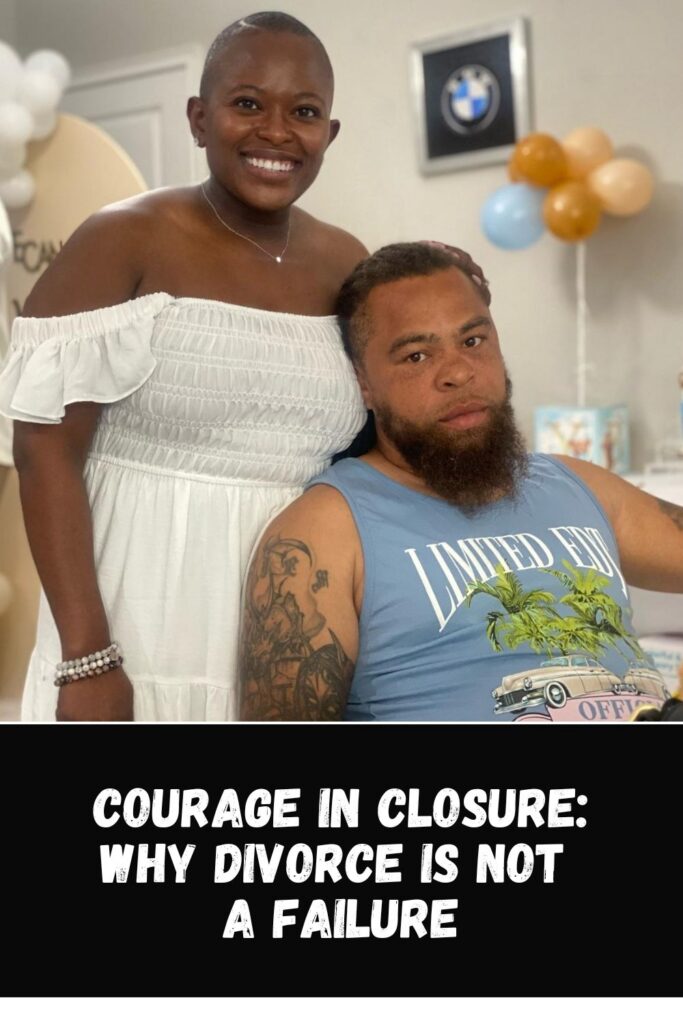
Courage in Closure: Why Divorce is Not a Failure




Separation and Divorce Are Not Failures — They Are Choices That Take Courage
This content is shared for storytelling, educational, and entertainment purposes only and is not a substitute for professional counseling or therapy.
There is a conversation that does not get nearly enough honest airtime, and it is this: sometimes relationships end. And that ending is not a failure. It is not a reflection of your worth. It is not evidence that you did something wrong. Sometimes, separation and divorce are the most courageous, most self-aware, and most loving decisions two people can make — for themselves and for each other.
We live in a culture that glorifies staying together at all costs. We celebrate milestone anniversaries as proof of success and treat divorce as a source of shame. But that narrative is incomplete, and for many women, it is quietly damaging. It keeps people in relationships that no longer serve them, out of fear of what leaving might say about them. It pressures couples to perform happiness rather than pursue it. And it completely ignores one of the most fundamental truths about human beings: we grow. We change. And sometimes, we grow in directions that no longer align with the person we chose at twenty-two or twenty-seven or thirty-five.
This is a conversation I want to have openly and without judgment. Because whether you are in the middle of a separation, quietly wondering if your relationship has run its course, or healing in the aftermath of a divorce — you deserve a space where this experience is treated with honesty, compassion, and respect.
Separation and divorce are not the end of your story. For many people, they are the beginning of the most important chapter.
Nobody Teaches Us How to Relationship
Let me say something I believe deeply: no one comes into this life knowing how to be in a relationship. Think about that for a moment. We spend years in school learning mathematics, history, and literature. We study for careers. We take driving tests. But when it comes to one of the most complex, emotionally demanding, and life-defining things we will ever do — build an intimate partnership with another human being — we are largely left to figure it out on our own.
We learn from watching our parents, for better or worse. We absorb messages from movies and music that are often wildly unrealistic. We carry the emotional patterns of our childhood into our adult relationships without fully understanding where those patterns come from or how they affect us. And then we are expected to merge our lives with a complete stranger — someone we are attracted to, maybe even in love with, but still, at the end of the day, a person we are only beginning to truly know — and make it work. Forever.
That is an enormous ask. And yet when it does not work out, we treat it as a personal failing rather than acknowledging the reality: relationships are genuinely hard. Building a life with another person is one of the most complex things a human being can undertake. The fact that some relationships do not last does not mean the people in them did not try hard enough or love deeply enough. Sometimes it means they were honest enough to acknowledge when the partnership had changed.
Every person you love is a teacher. Every relationship is a curriculum. The lesson does not fail just because the course ends.
You Are Allowed to Outgrow Your Person
Personal growth is not optional. It is the natural condition of a human life. As we age, experience things, heal old wounds, pursue new goals, and discover more about who we are, we change. That is not a problem. That is called living.
But here is what nobody likes to say out loud: sometimes you grow in a direction your partner does not follow. And sometimes they grow in a direction you cannot follow. This does not mean anyone is wrong. It does not mean the relationship was a mistake. It means two people who may have been perfectly matched at one stage of life have arrived at a different stage, and the match no longer fits the way it once did.
I have said many times that each partner we have in our lives is a learning experience. A new blank slate. Every relationship teaches us something about who we are, what we need, what we value, and what we are willing to carry and what we are not. That is not failure. That is growth. And growth sometimes requires change — including the courageous change of releasing a relationship that has run its natural course.
There is a kind of courage in admitting that. It takes far more bravery to say, honestly, “I love you and I have outgrown this relationship” than to stay and quietly resent each other for years. Choosing to let go — consciously, carefully, and with mutual respect — is not giving up. It is growing up.
The Courage It Takes to Choose an Amicable Ending
If separation and divorce are going to happen — and for many couples, they are — then how they happen matters enormously. The difference between a separation handled with grace and one handled with destruction is not just about legal paperwork or who keeps the furniture. It is about the long-term emotional wellbeing of everyone involved, including any children who are watching and learning from how their parents handle one of the hardest transitions of adult life.
An amicable separation — one where both parties choose to prioritise respect over retaliation, communication over chaos, and the long view over short-term hurt — is genuinely one of the hardest things two people can do together. It requires both partners to manage their own pain while still treating the other person humanely. It requires setting ego aside. It requires choosing the relationship that will exist after the romantic partnership ends: whether you will be co-parents, whether you will eventually be in each other’s lives in some capacity, and what story you will tell about each other as time passes.
That kind of intentional, conscious uncoupling — to use a term that has entered our cultural vocabulary in recent years — is not weakness. It is an act of emotional maturity that most people never fully achieve. It is choosing dignity over drama. It is recognising that the love you had for each other does not have to transform into hatred just because the relationship is ending.
You can honour what you had while still choosing to walk away. Love does not have to become war.
What the Work of Separation Actually Looks Like
People often talk about the work of maintaining a marriage. And that work is real. But what they less often discuss is the equally real, equally demanding work of ending one.
Separation and divorce require you to grieve. Not just the person, but the version of yourself that existed in that relationship, the future you had imagined, the life you had built together. That grief is legitimate and it deserves space. Rushing past it, numbing it, or pretending it is not there because you were the one who chose to leave — none of those approaches serve you long-term.
The work of separation also requires you to look honestly at yourself. Not as an exercise in self-blame, but as an act of self-awareness. What did you bring to this relationship? What patterns did you repeat? What did this experience teach you about your own emotional needs, your own communication style, your own triggers? Because if you do not do that inner work, you carry it all into the next chapter — and the chapter after that.
This is also the work of not bringing baggage into what comes next. Every new relationship deserves a clean slate. Comparison is the enemy of new love. When you find yourself measuring a new partner against an old one — whether favourably or unfavourably — you are not fully present in the new relationship. You are still living in the old one. The work is to process what happened, learn from it, and then genuinely release it so that what you bring forward is wisdom, not wound.
- Give yourself permission to grieve fully without rushing the timeline
- Work with a therapist or trusted guide to process the emotional layers
- Resist the urge to compare your next relationship to the last one
- Identify the patterns that need to change before you build something new
- Choose the narrative you carry forward — make it one of growth, not bitterness
Reframing the Narrative: Divorce as a Chapter, Not a Conclusion
The way we talk about divorce in this culture is almost entirely focused on loss. The marriage failed. The relationship ended. Everything fell apart. But that framing strips something important from the story: the whole of what came before, and the whole of what is still to come.
A relationship that lasted ten years and ended in divorce gave you a decade of experience, possibly children you love beyond measure, lessons that shaped who you are, and a clearer understanding of what you need and what you deserve. That is not nothing. That is not failure. That is a chapter in a longer story — one that is still being written.
The women I have spoken to and heard from who have navigated separation and divorce with the most grace are not the ones who pretended it did not hurt. They are the ones who refused to let the ending define the whole. They honoured what the relationship was. They grieved what it could not become. And then they chose — deliberately and courageously — to begin again.
Beginning again is its own kind of brave. It means being vulnerable enough to love again after being hurt. It means showing up as a whole person rather than a half of something that no longer exists. It means trusting yourself to make different choices, better choices, more aligned choices — because of everything you now know that you did not know before.
Divorce does not mean you failed at love. It means you are brave enough to keep seeking it — even when it requires starting over.
What Nobody Tells You About Starting Over
Starting over after a separation or divorce is both harder and better than most people tell you it will be. It is harder because grief is not linear. Some days you will feel free and clear and genuinely excited about your life. Other days the loss will hit you sideways and you will not understand why. Both of those days are normal. Both of them are part of the process.
It is better because the version of you that emerges on the other side of a difficult ending — if you do the inner work — is often more self-aware, more grounded, and more intentional about love than you have ever been. You know yourself better. You know what you will and will not accept. You understand your own needs in ways you may not have before. That self-knowledge is not something to grieve. It is something to celebrate.
Starting over also means resisting the urge to jump immediately into something new just to fill the space. The space — the quiet, sometimes uncomfortable time between one relationship and the next — is where the most important growth happens. It is where you learn to be alone without being lonely. It is where you rediscover who you are outside the context of a partnership. And it is where you build the foundation of genuine readiness for what comes next.
There is no standard timeline for this. Do not let anyone rush you. Do not let cultural pressure or well-meaning family members or social media declarations push you into a new chapter before you are truly ready. The right next step always comes from a place of wholeness, not desperation. And wholeness takes time.
Takeaways: What to Carry With You
1. Separation and divorce are not signs of failure.
They are sometimes the most courageous and self-aware decisions two people can make. Choosing to end a relationship that is no longer serving either of you is an act of honesty, not defeat.
2. No one is taught how to be in a relationship.
We are all figuring this out as we go, carrying the patterns of our pasts and doing the best we can with the tools we have. Grace for yourself and your former partner is essential.
3. Growing apart is a natural part of being human.
People change. That is not a problem — it is life. Outgrowing a relationship does not mean you did something wrong. It means you evolved.
4. An amicable separation is one of the hardest and bravest things you can do.
Choosing dignity over drama, communication over chaos, and long-term respect over short-term retaliation is a profound act of emotional maturity.
5. Do the inner work before you begin again.
Understand what you brought to the relationship. Grieve what you are leaving behind. Release the comparison and the baggage. Then — and only then — step forward with a genuinely clean slate.
6. Starting over is not the end of the story.
It is often the beginning of the most intentional, most self-aware, most aligned chapter of your life. The courage to begin again is one of the most powerful things you can choose.
Listen to the Real Talk Series on Sherley’s Show
This conversation — honest, unfiltered, and deeply human — is exactly what we dig into on Sherley’s Show. Our Real Talk Series features candid conversations between me and my husband about the real terrain of long-term partnership: what keeps couples together, what pulls them apart, and everything in between. These are not curated highlight reels. These are real talks.
If this post resonated with you, if you are navigating the complexities of a relationship ending or wondering what sustainable love actually looks like over the long haul, pull up a seat and join the conversation.
Listen to the Real Talk Series on Sherley’s Show
Tune into the Conversations format — where co-host Kira and I get into topics like infidelity, heartbreak, healing, and what it really means to move forward
Explore our Interviews format — expert conversations that go deep on the things we are all navigating
All episodes are available at sherleysshow.com. Subscribe, rate, and share with a woman in your life who needs to hear this.
Are You Ready to Build Your Own Podcast?
If this post found you not just as a listener, but as a woman with a story to tell and a platform you have been thinking about building — this part is for you.
At Sherley’s Show, beyond the relationship content, I work with women who are ready to start or grow a podcast as a real income stream. Whether you are brand new to podcasting or you already have a show and want to level up, I have resources built specifically for you.
Here is what is available right now:
- 1-on-1 Podcast Consultation — A private 60-minute session to map out your podcast strategy, clarify your niche, and build a plan that fits your life and income goals
- Free Downloads — The Podcast Launch Checklist, Equipment Guide, and Launch Guide are available now at no cost at sherleysshow.com
- Free Webinar — Coming soon: a live webinar walking you through how to launch a podcast and position it as an income stream from day one
- eBook — A comprehensive guide for aspiring women podcasters is on the way — join the waitlist now so you are first to know
- Trauma to Profit — An exciting new offering is coming that helps women transform their lived experiences into a powerful, monetised platform — stay tuned for details
These offers are exclusively for women who want to build a podcast as an income stream. If that is you — whether you are just starting out or already have a mic and a dream — head to sherleysshow.com to explore everything that is available and get on the list for what is coming.
Your voice deserves a platform. Let’s build it. → sherleysshow.com
Sherley’s Show is learning and growing every single day. We aim to uplift all marginalized voices both on this podcast and in real life. Please note that we are always striving to change the problematic language that society has internalized in us. Thank you for your patience as we aim to strip certain phrases from our vocabulary.
Would you like to be a guest
Are you interested in getting your opinion out about a particular topic but don’t know how to do so? If so, here is an opportunity to do so to share your point of view, PLUS get your message and voice out there. It is always a great way to know about different perspectives and enrich ourselves through knowledge sharing.
Submit your relationship question.
Sherley’s Show provides an atmosphere where every woman is comfortable growing into their best self. Sherley’s Show is a no judgment podcast where we discuss how to rise strong out of all types of obstacles that come with relationships. Through personal life experiences and discussions ranging from infidelity, trust, forgiveness, sex, heartbreak, self love, therapy and more, we offer words of empowerment as you strive to build and maintain all of the relationships in your life. You may be going through something that is unique and difficult. Sharing your story gives others comfort and could also be helping someone else. Let them know they are not alone. Everyone has a story, do not let fear hold you back.
Disclosure: This post contains affiliate links, I will get a commission if you decide to make a purchase through any of my links, at no cost to you. Please read my disclosure for more info.

Want to launch a podcast?
FRee Resource!
Download Sherley’s FREE Bootcamp Podcast Launch Checklist! The no-fluff, step-by-step roadmap for busy women ready to finally launch the podcast they’ve been dreaming about.
At Sherley's Show, we believe that when women feel seen and supported, anything is possible. Whether you're tuning in for inspiration, education, or community—you belong here.



next

say goodbye to being the side chick
When you find yourself really settling with the reality that you are the side chick, when you find yourself tired of the games and/or the complacency, it’s time to ask yourself a few questions.
next

why is therapy important?
Solo therapy, partnered therapy, or group therapy... what exactly are the benefits? If you’re still on the fence about whether or not you should go and if therapy can really do anything for you... this post is for you.
next
CONNECT
elsewhere:

STAY AWHILE AND READ
THE BLOG

BINGE
THE PODCAST
The place where we chat about obstacles that come out of relationships and how to rise up from them. Self-love, marriage, infidelity, sex, heartbreak, and more.

HANG OUT ON

Comments +