
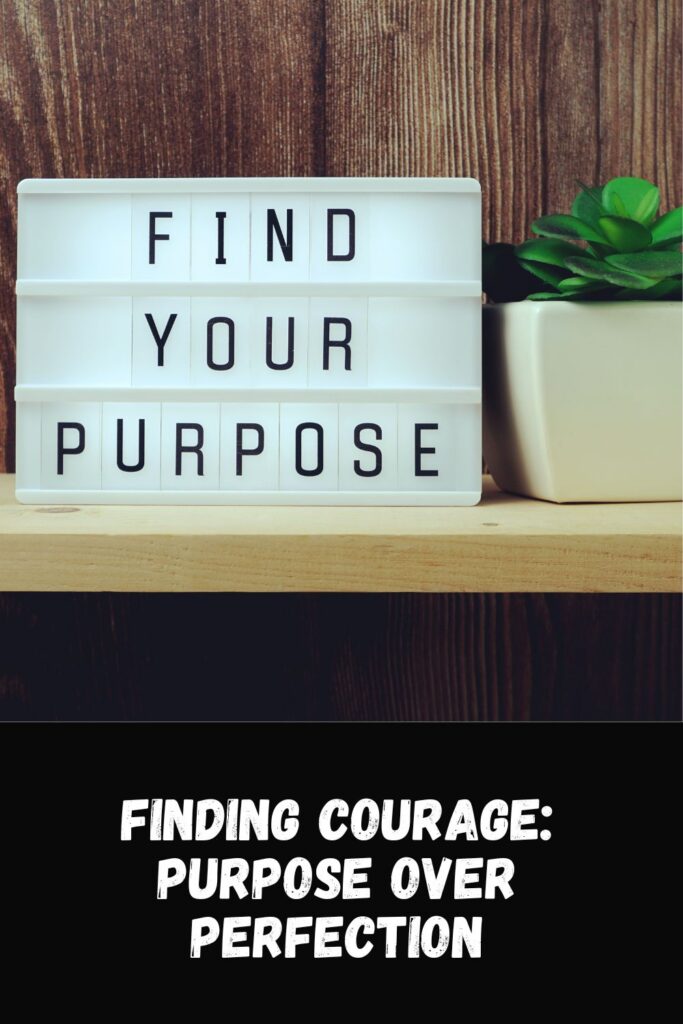
Finding Courage: Purpose Over Perfection



Purpose Over Perfect: Finding the Nerve to Speak Before You Feel Ready
Perfect readiness is a moving target that rarely arrives. Here’s what actually carries women through the fear of speaking before they feel fully ready.
There is a version of readiness that never arrives — a feeling of being fully prepared, fully calm, fully certain, right before you do something that matters. I have talked to a lot of women waiting for that feeling before they’ll let themselves start building a platform, and I want to be honest with you: I don’t think that feeling is coming, at least not before you start. What actually carries most women through is not perfect readiness. It’s purpose.
I’ve come to think of this as one of the quieter truths in this entire body of work — quieter than the practical frameworks, harder to put into a checklist, but underneath almost every other pillar in one way or another. So I want to spend a full post on it directly, rather than letting it stay implicit.
The Difference Between Ready and Called
Ready is a feeling — a sense of internal calm and certainty that, for most meaningful work, tends to arrive after you’ve already started, not before. Called is something different. It’s a sense that this matters enough to move on, even without the calm. I did not feel ready the first time I spoke publicly about the hardest season of my marriage. My hands shook. I rewrote the same paragraph a dozen times. What I had wasn’t readiness — it was a conviction that staying silent would cost more than speaking imperfectly would.
That distinction matters because if you’re waiting for the first feeling, you may be waiting indefinitely. If you can access the second one, you can move even while the fear is still present, which is a far more honest description of what courage actually looks like in practice.
Where Purpose Comes From, for Me
For me, that sense of purpose has always been tied to faith — a belief that what I went through was not wasted, and that part of what it was for was to help someone else standing where I once stood. I don’t say that to suggest everyone needs a faith framework to find their own version of this. But I do think everyone needs some version of a why that is bigger than their own comfort in the moment, because comfort alone will rarely be enough to override the fear of speaking.
When the fear shows up now — and it still does, even after years of doing this — I don’t try to argue myself out of the fear directly. I go back to the why. Who is on the other side of this, waiting to hear that they’re not alone in what they’re going through? That question tends to move me forward faster than any amount of trying to talk myself into feeling calm.
Perfectionism Disguised as Preparation
I want to name something directly: a lot of what looks like responsible preparation — one more course, one more round of edits, one more year of “getting ready” — is sometimes perfectionism wearing a more acceptable costume. Genuine preparation has a natural stopping point. Perfectionism does not; it simply generates a new reason to wait every time the previous one gets resolved.
One way to tell the difference: ask whether the thing you’re waiting to feel or acquire has a concrete finish line, or whether it’s the kind of goal that could keep moving indefinitely, no matter how much progress you make. “Feeling fully confident” rarely has a finish line. “Completing a specific framework” does. If what you’re waiting for falls into the first category, it may be worth examining honestly whether purpose, not more preparation, is the thing that will actually move you.
What This Looks Like in Practice
Purpose over perfect doesn’t mean recklessness. It doesn’t mean skipping the real work of healing, boundary-setting, and strategic positioning covered elsewhere in this framework. It means, once that groundwork is genuinely in place, refusing to let the absence of a feeling — perfect calm, total confidence — be the final gatekeeper standing between you and starting.
Practically, this might look like publishing the post while your hands are still a little unsteady. Recording the podcast episode before you’ve fully talked yourself out of every fear about how it will land. Sending the FastTrack application before you feel like you’ve earned a spot. The feeling of earned confidence, in my experience, tends to arrive after the action, built from the evidence of having survived it — not before, as a precondition for taking it.
I think of confidence less like a light switch and more like a muscle that only strengthens under actual load. You cannot build it by thinking about lifting. You build it by lifting, imperfectly, before you feel strong enough to. Every woman I’ve watched go on to build something real followed roughly that same order — action first, confidence catching up after, never the reverse.
How to Find Your Own Version of Purpose
If faith isn’t the frame that resonates with you, the same underlying force shows up under other names — legacy, conviction, a debt you feel toward the version of yourself who needed this and didn’t have it, a simple refusal to let a hard season go to waste. What matters isn’t the label. What matters is identifying, honestly, what your own why actually is, so you have something to return to when the fear shows up and readiness still hasn’t arrived. Write it down somewhere you’ll actually see it again. On the days motivation runs out — and it will — a clearly named purpose tends to outlast it.
A Word for the Woman Who Feels Like She’s Waiting on God, or Waiting on Herself
If part of what’s holding you back is a sense that you’re waiting for a sign, a door to open, a clearer confirmation that this is the right time — I understand that instinct, and I’ve lived inside it myself. What I’ve come to believe is that the door often opens because you walked toward it, not before. Purpose rarely announces itself with total certainty in advance. More often, it reveals itself gradually, through the act of moving forward and paying attention to what happens next.
You don’t need permission from a feeling that was never going to arrive. You need a why big enough to move without it.
This Is What Carries You Through Every Pillar
Purpose isn’t a separate, sixth pillar of the Trauma-to-Profit™ framework — it’s the current underneath all five. It’s what makes Recognize feel worth doing instead of just painful. It’s what makes Release feel like protection instead of restriction. It’s what makes Rebuild, Reframe, and Revenue feel like building something meaningful instead of just building a business for its own sake.
If you’ve been waiting to feel ready before you start, I’d gently ask you to sit with a different question instead: not am I ready, but who is this actually for, and can I move toward them even while the fear is still in the room with me? For most women I’ve watched do this work, that question — not the feeling of readiness — is what finally gets them moving.
You are allowed to still be afraid on the day you start. Fear and purpose are not opposites that cancel each other out. They can occupy the same body at the same time, and in my experience, they almost always do, right up until the moment you look back and realize the fear quietly became smaller than the thing you built anyway.
Key Takeaways
- Perfect readiness is a feeling that, for most meaningful work, arrives after you start, not before — waiting for it can mean waiting indefinitely.
- Purpose — a sense that this matters enough to move on despite the fear — is what actually carries most people through, more reliably than trying to talk yourself into feeling calm.
- Some “preparation” is perfectionism in disguise — a useful test is whether what you’re waiting for has a real finish line or could keep moving indefinitely.
- Purpose over perfect doesn’t mean skipping real groundwork — it means not letting the absence of a feeling be the final gatekeeper once that groundwork is done.
- Purpose functions as the current underneath all five pillars of the Trauma-to-Profit™ framework, not a separate step of its own.
Call to Action
Start With Trauma-to-Profit™ (T2P™)
The five-pillar framework behind everything in this post. The free Introduction PDF launches August 1, 2026, and the complete T2P™ E-Book follows on October 1, 2026. Visit the page now to see the full framework and be notified the moment each one goes live.
Apply the Framework Inside FastTrack
FastTrack is the boutique 90-day podcast launch accelerator built entirely on the T2P™ methodology — 15 seats, three cohorts a year, application only. The waitlist is open now; Cohort 1 applications open February 1, 2027.
Get Personalized Clarity
If you want direct, one-on-one strategy before you commit to a bigger step, book a 60-minute 1:1 Consultation with Sherley — $297, one payment, no packages.
Grab the Podcasting E-Book
“Find Your Voice: The Woman Behind the Mic” is the 10,000-word, step-by-step roadmap for planning, recording, and launching your podcast — $67.
Reserve Your Seat at the Free Webinar
“Story to Show: Launch Your Podcast With Clarity, Strategy, and Confidence” is a live training on turning your story into authority using the T2P™ framework.
Listen to Sherley’s Show
Hear these ideas in conversation across all three formats — the Real Talk Series with Sherley and Kalief, Conversations with Sherley and Kira, and Interviews with guest experts.
Sources
Internal Sources
Transform Pain into Power: Unlock Your Business Potential
Build Authority With Your Story: Trauma-to-Profit™ Explained
Trauma-to-Profit™ Framework Overview
Sherley’s Show is learning and growing every single day. We aim to uplift all marginalized voices both on this podcast and in real life. Please note that we are always striving to change the problematic language that society has internalized in us. Thank you for your patience as we aim to strip certain phrases from our vocabulary.
Would you like to be a guest
Are you interested in getting your opinion out about a particular topic but don’t know how to do so? If so, here is an opportunity to do so to share your point of view, PLUS get your message and voice out there. It is always a great way to know about different perspectives and enrich ourselves through knowledge sharing.
Submit your relationship question.
Sherley’s Show provides an atmosphere where every woman is comfortable growing into their best self. Sherley’s Show is a no judgment podcast where we discuss how to rise strong out of all types of obstacles that come with relationships. Through personal life experiences and discussions ranging from infidelity, trust, forgiveness, sex, heartbreak, self love, therapy and more, we offer words of empowerment as you strive to build and maintain all of the relationships in your life. You may be going through something that is unique and difficult. Sharing your story gives others comfort and could also be helping someone else. Let them know they are not alone. Everyone has a story, do not let fear hold you back.
Disclosure: This post contains affiliate links, I will get a commission if you decide to make a purchase through any of my links, at no cost to you. Please read my disclosure for more info.

Want to launch a podcast?
FRee Resource!
Download Sherley’s FREE Bootcamp Podcast Launch Checklist! The no-fluff, step-by-step roadmap for busy women ready to finally launch the podcast they’ve been dreaming about.
At Sherley's Show, we believe that when women feel seen and supported, anything is possible. Whether you're tuning in for inspiration, education, or community—you belong here.



next

say goodbye to being the side chick
When you find yourself really settling with the reality that you are the side chick, when you find yourself tired of the games and/or the complacency, it’s time to ask yourself a few questions.
next

why is therapy important?
Solo therapy, partnered therapy, or group therapy... what exactly are the benefits? If you’re still on the fence about whether or not you should go and if therapy can really do anything for you... this post is for you.
next
CONNECT
elsewhere:
STAY AWHILE AND READ
THE BLOG

BINGE
THE PODCAST
The place where we chat about obstacles that come out of relationships and how to rise up from them. Self-love, marriage, infidelity, sex, heartbreak, and more.

HANG OUT ON

Comments +