
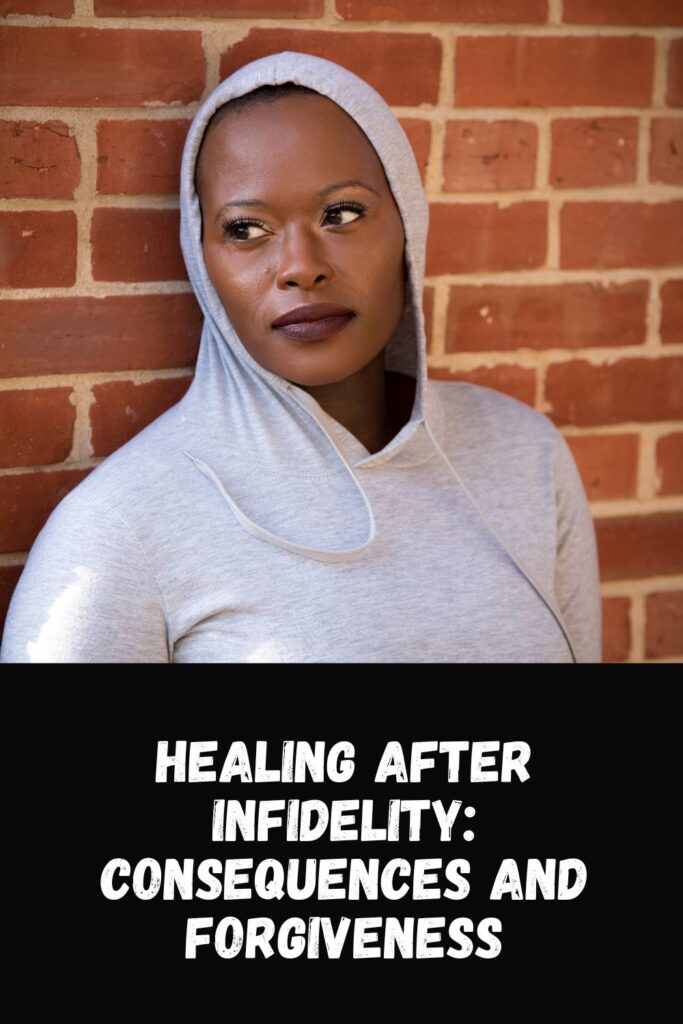
Healing After Infidelity: Consequences and Forgiveness




Consequences, Recovery, and Forgiveness: What Healing Really Looks Like After Infidelity
This content is shared for storytelling, educational, and entertainment purposes only and is not a substitute for professional counseling or therapy.
The hardest part of infidelity is not the moment you find out. I know that sounds backwards, but stay with me. The discovery is one brutal blow — it lands, it knocks the wind out of you, and then it is done. What comes after is the part nobody hands you a manual for: the long, foggy stretch where you have to decide whether to stay, and if you stay, what staying is actually going to cost.
When I wrote about surviving heartbreak, I told you how I clawed my way back to myself after Kalief’s betrayal. But I left one question mostly untouched, and it happens to be the one I get asked the most: okay, Sherley, you stayed — so what were the consequences? What did recovery actually look like? And underneath all of that sits the real question, the uncomfortable one: is your partner supposed to bend to your every demand to make you comfortable again, or is healing something the two of you have to build together?
Let me get into it, honestly, the way I always do.
First, the obvious: yes, there have to be consequences
I do not believe in cheap forgiveness. I never have. When someone betrays you, something has to shift. There has to be a cost — because an action that carries no cost quietly teaches a person that they can do it again. Accountability with no consequence is just a pretty word that means nothing.
If your partner stepped out and the relationship simply rolls on like nothing ever happened, you have not forgiven anything. You have swept it under the rug. And swept dirt always, always resurfaces — usually at the worst possible time. So yes, consequences are real, and they are necessary. The trust that was broken does not come back for free. It has to be earned back, and earning takes time, effort, and a kind of humility a lot of people are not willing to give. That is the price of the wrong they did, and they do not get to set that price to zero just because they said sorry.
But a consequence is not the same as a punishment
Here is where it gets tricky — and where I have watched a lot of relationships quietly die even after both people swore up and down that they wanted to stay.
There is a real difference between a consequence and a punishment, and you have to understand it, or you will burn the whole thing down trying to save it.
A consequence is the natural cost of broken trust: more transparency, more patience, a slower rebuild, the discomfort of counseling, the work of answering hard questions you wish you did not have to ask. A punishment is something else entirely. Punishment is when the betrayal becomes a weapon you pick up every single time you want the upper hand. It is throwing it in their face during arguments that have nothing to do with it. It is making your partner grovel with no end in sight. It is demanding every password, every location, every minute of their day — forever, with no path back to trust. Punishment has no finish line. It is built to keep a person on their knees.
And let me be honest with you, because I always am: I understand the pull. When I was hurting, a part of me wanted Kalief to suffer the exact way I was suffering. I wanted him to feel it. I have admitted that before and I will admit it again. But wanting someone to hurt and building an entire relationship around keeping them hurting are two very different things. One is human. The other is slow poison — and it poisons you right alongside them.
You cannot make unreasonable demands and call it healing
Somebody needs to hear this, so I am going to say it plainly: you cannot make unreasonable requests of your partner and dress it up as recovery.
Yes, you were wronged. Yes, you absolutely get to ask for what you need in order to feel safe again. But “what I need to feel safe” and “total control over another grown adult” are not the same thing, and we have to stop pretending they are. If your requests have no ceiling — if there is genuinely nothing your partner could ever do that would be enough — then you are not rebuilding anything. You are demanding payment on a debt that can never be paid off. And no human being can live inside that forever. Eventually they stop trying. Not always because they stopped loving you, but because they finally understood the door was never going to open, no matter how long or how hard they knocked.
Reasonable sounds like this: I need you in counseling with me. I need honesty even when it is uncomfortable. I need you to understand that my trust is going to come back slowly, and I need you to be patient with that. I need you to show me, consistently and over time, that you are someone I can lean on again.
Unreasonable sounds like this: I need to control everything you do. I need you to cut off every person I feel insecure about, permanently. I need you to apologize every day for the rest of your life. I need you to stay miserable so that I can feel better.
One of those is a path forward. The other is a cage you both end up living in.
It has to be mutual — not one person obeying the other
So should your partner just give in to all of your demands to keep you comfortable? No. And I am telling you that as the person who was betrayed.
Recovery is not one person dictating terms while the other one simply obeys. It is a mutual agreement. It is two people sitting down — ideally with help in the room — and deciding together what rebuilding is actually going to look like. The person who broke the trust has to be willing to do the work, all of it, without sighing and dragging their feet. But the person who was hurt also has to be willing, eventually, to walk toward the bridge instead of standing there with a lighter. Both of those things have to be true at the same time, or it simply does not work.
I know that is a hard pill, especially if you are the one who got hurt. It feels deeply unfair that you should have to do any work at all when you were not the one who cheated. But healing a relationship is not about fairness in that moment. It is about whether two people genuinely want to build something new on top of the wreckage. If only one person is building, you do not have a relationship anymore. You have a project — and you are the only one holding the hammer.
What recovery actually looks like
Recovery is unglamorous. Let me tell you what it really looks like, because it is nothing like the movies sell you.
It looks like a whole lot of hard conversations. It looks like counseling sessions where you cry, where you raise your voice, where you finally say the ugly thing out loud so a professional can help you hold it. And please — get the professional. A good therapist was one of the only reasons Kalief and I made it to the other side. There is no shame in sitting in that chair; it is one of the bravest things two people can do together.
It looks like transparency that is offered freely, not transparency you have to squeeze out under interrogation. It looks like patience on both sides. It looks like good days that get suddenly interrupted by a bad one — a trigger, a memory, a song that knocks the wind out of you out of nowhere — and then choosing to keep going anyway. It looks like rebuilding closeness slowly, learning each other all over again, sometimes learning each other for the very first time.
And it takes time. Real time. Not a tidy week. Not one good apology and a nice dinner. Trust gets rebuilt in a thousand small, boring, consistent moments where your partner does exactly what they said they were going to do. That is the work. There is no shortcut, and anybody who promises you one is selling you something.
What forgiveness actually looks like
Now, forgiveness. This is the one people get most wrong, so let me slow down here.
Forgiveness does not mean that what happened was okay. It was not okay. It is never going to be okay. Forgiving someone is not signing a piece of paper that says “this was fine.” It is not forgetting, either — you do not get amnesia, and you should not perform it for anybody.
What forgiveness actually is, is a decision to stop letting the wound run your whole life. It is loosening the grip the betrayal has on you so that you can finally breathe again. And here is the part that genuinely surprised me when I lived it: forgiveness is something you do as much for yourself as for them. That rage is heavy, and most of the time the person carrying it is the only one it is crushing.
But here is the line I will die on: forgiveness does not erase accountability. You can forgive someone and still hold them fully responsible for what they did. You can forgive someone and still expect them to do every bit of the work. Forgiveness and consequences are not opposites — they live side by side. I forgave Kalief. That did not mean he got to skip the rebuilding. It meant I chose to walk through the rebuilding without poison sitting in my heart.
And if your partner will not honor any of it
I would be lying to you if I wrapped this up like it always works out. It does not.
Sometimes you set reasonable terms. You offer real forgiveness. You do your part, faithfully — and the other person still does not do theirs. They are not transparent. They will not go to counseling. They treat your healing like an inconvenience they are tired of hearing about. If that is where you are, then the consequence is no longer about passwords or patience. The consequence is that you are allowed to leave.
Choosing to work it out does not make you weak. Choosing to walk away does not make you a quitter. Only you know what is right for your life. Do not let society, your group chat, or anyone else’s loud opinion make that decision for you — and if you are struggling to find your footing through any of this, a good counselor can help you hear your own voice again.
KEY TAKEAWAY
Consequences after infidelity are necessary — but they are not a life sentence. There is a difference between a consequence and a punishment: one leaves a path back to trust, the other keeps a person on their knees forever. Recovery is not one partner obeying the other’s every demand; it is a mutual agreement built on reasonable boundaries, real transparency, time, and usually professional help. And forgiveness is not a free pass — you can forgive someone and still hold them fully accountable. Both things can be true at once.
Be Yourself. Voice Yourself. Love Yourself.
Keep going with me. If this hit something in you, I go even deeper on infidelity, accountability, and healing over on the podcast. Come sit with me and Kira in our Conversations series, where we say the parts of heartbreak and betrayal out loud that most people are too scared to touch. [Conversations with Kira]
Prefer to hear me and Kalief work through the hard relationship stuff together? That’s our Real Talk Series. [Real Talk Series]
Did this one land for you? Tell me in the comments — I read every single one.
Before you go, keep reading. Start with the two post this one grew out of:[Infidelity: The Hidden Layer of Accountability] [How To Make A Relationship Work Even After A Heartbreak]. Then dig into [Are You Stupid If You Stay After Your Partner Cheated] and [Learning your partner’s love language].
Sherley’s Show is learning and growing every single day. We aim to uplift all marginalized voices both on this podcast and in real life. Please note that we are always striving to change the problematic language that society has internalized in us. Thank you for your patience as we aim to strip certain phrases from our vocabulary.
Would you like to be a guest
Are you interested in getting your opinion out about a particular topic but don’t know how to do so? If so, here is an opportunity to do so to share your point of view, PLUS get your message and voice out there. It is always a great way to know about different perspectives and enrich ourselves through knowledge sharing.
Submit your relationship question.
Sherley’s Show provides an atmosphere where every woman is comfortable growing into their best self. Sherley’s Show is a no judgment podcast where we discuss how to rise strong out of all types of obstacles that come with relationships. Through personal life experiences and discussions ranging from infidelity, trust, forgiveness, sex, heartbreak, self love, therapy and more, we offer words of empowerment as you strive to build and maintain all of the relationships in your life. You may be going through something that is unique and difficult. Sharing your story gives others comfort and could also be helping someone else. Let them know they are not alone. Everyone has a story, do not let fear hold you back.
Disclosure: This post contains affiliate links, I will get a commission if you decide to make a purchase through any of my links, at no cost to you. Please read my disclosure for more info.

Want to launch a podcast?
FRee Resource!
Download Sherley’s FREE Bootcamp Podcast Launch Checklist! The no-fluff, step-by-step roadmap for busy women ready to finally launch the podcast they’ve been dreaming about.
At Sherley's Show, we believe that when women feel seen and supported, anything is possible. Whether you're tuning in for inspiration, education, or community—you belong here.



next

say goodbye to being the side chick
When you find yourself really settling with the reality that you are the side chick, when you find yourself tired of the games and/or the complacency, it’s time to ask yourself a few questions.
next

why is therapy important?
Solo therapy, partnered therapy, or group therapy... what exactly are the benefits? If you’re still on the fence about whether or not you should go and if therapy can really do anything for you... this post is for you.
next
CONNECT
elsewhere:

STAY AWHILE AND READ
THE BLOG

BINGE
THE PODCAST
The place where we chat about obstacles that come out of relationships and how to rise up from them. Self-love, marriage, infidelity, sex, heartbreak, and more.

HANG OUT ON

Comments +