
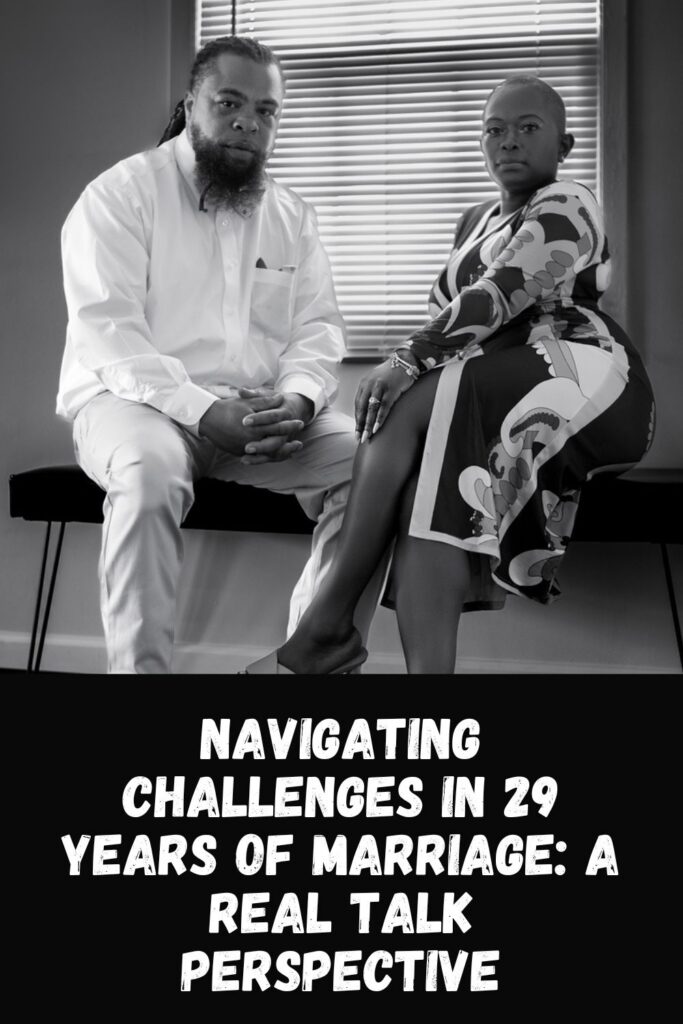
Navigating Challenges in 29 Years of Marriage: A Real Talk Perspective




Marriage Is Never Finished Work: A 29-Year Journey Through Connection and Challenge
This content is shared for storytelling, educational, and entertainment purposes only and is not a substitute for professional counseling or therapy.
To hear our 25th year conversation in real time, listen to the full episode below. Make sure you tune into the show. You’ll get all the raw, unfiltered moments and deeper insights.
Podcast Blog post: Celebrating and Surviving 25 Years Together
Twenty-nine years. That is not a milestone most people talk about casually. When my husband and I reflect on nearly three decades of marriage, what strikes us most is not some romantic highlight reel or the notion that we have somehow figured it all out. Rather, it is the profound realisation that marriage is not a destination. It is a continuous practice, a daily commitment to showing up, communicating, adapting, and choosing each other—even when the gloss has worn off and life has thrown everything at you but the kitchen sink.
If you are reading this, you may be in the early glow of marriage, navigating the practical challenges of a mid-range partnership, or you may be decades in and wondering if the relationship you have built can still hold intimacy, joy, and connection. The answer to that last question, in our experience, is absolutely yes. But it requires something that is often missing from romantic narratives: honest work, ongoing conversation, and a willingness to evolve together.
In this post, I want to share what we have learned about long-term marriage—the communication shifts that have sustained us, how we have rekindled intimacy through major life changes, and why the hardest days do not mean you have failed. Because here is the truth nobody tells you: not every day is great. Not every week or month is peaches and cream. But when you commit to working through the valleys as a team, the marriage not only survives—it deepens.
To hear our 28th year conversation in real time, listen to the full episode below. Make sure you tune into the show. You’ll get all the raw, unfiltered moments and deeper insights.
Podcast Blog post: Navigating Love’s Challenges Together: A 28-Year Journey
THE REALITY OF LONG-TERM MARRIAGE: WHAT NOBODY WARNS YOU ABOUT
When we got married, we were young and hopeful, like most couples. We believed love was enough. And in the honeymoon phase, it felt like it was. But roughly seven to ten years in, reality shifted. The excitement that fuelled those early years began to plateau. Life got busier. Children came. Careers demanded more. Financial pressures mounted. And somewhere in the middle of managing all of it, we discovered something uncomfortable: staying married through the middle decades requires a different skill set than falling in love ever did.
Research on long-term marriage reveals something that might surprise you. Contrary to the narrative that all marriages decline over time, studies show that for couples who stay the course, marital satisfaction often remains stable or even improves after about twenty years. But—and this is critical—that improvement does not happen by accident. It happens because couples who last do something different. They actively work on their relationship. They communicate. They adapt.
In our first decade, conflict was often about external things: money, where to live, whose family to visit. But by year fifteen, we realised our conflicts were deeper. They were about unspoken expectations, emotional needs that had not been voiced, and the slow accumulation of small resentments that had gone unaddressed. We were not broken. We were just beginning to understand that marriage, like any living thing, requires intentional care.
COMMUNICATION SHIFTS: FROM ASSUMPTION TO HONEST CONVERSATION
If I had to name the single most important thing that has kept our marriage alive through twenty-nine years, it is our willingness—sometimes painful, often uncomfortable—to talk about the hard things.
Early on, we communicated mostly about logistics and shared interests. We talked about our days, our plans, our dreams. It was surface-level in many ways, but it was earnest. Over time, as life got more complex and we became busier, we realised we had fallen into patterns where we assumed we knew what the other person thought or felt. We stopped asking clarifying questions. We started making decisions in silos. We became roommates with a shared mortgage rather than partners.
The shift in our communication came when we stopped assuming and started asking. Instead of: “You clearly do not care about spending time together,” it became: “I am feeling disconnected from you. Can we talk about what is happening?” Instead of letting resentment build over unequal household responsibilities, we began having regular conversations about what needed to shift and how we could support each other differently.
One of the most useful tools we discovered is what we now call “checking in”—and this is something we explore frequently in our Real Talk Series, which is the two-person, couple-based format where my husband and I discuss relationship topics from both perspectives. A check-in is not a full-blown argument or a deep therapeutic session. It is a fifteen-minute conversation where you both get space to say: “Here is what I am feeling. Here is what I need. What do you need from me?” No defensiveness. No interrupting. Just listening and being heard.
This shift in communication has been fundamental to our survival as a couple. Because let me be honest: if you do not actively communicate over nearly thirty years, you will gradually become strangers who happen to live in the same house.
THE TRUTH ABOUT THE HARD DAYS
Here is what I want to say clearly, because I think it is important: not every day in our marriage has been good. Not every week. There have been months where I wondered if we would make it. There have been seasons where the emotional distance between us felt unbridgeable. There have been nights when I went to bed angry, hurt, or simply exhausted by the weight of trying.
And that is okay. That is actually normal.
One of the most damaging myths about long-term relationships is that if you are experiencing real conflict or disconnection, something has gone wrong. But conflict is not a sign of failure—it is a sign of two imperfect humans trying to build a life together. What matters is not whether you have conflict. It is how you navigate it.
In our mid-marriage years, we had a particularly difficult stretch. Life was demanding in ways we had not anticipated. We were both stressed, both feeling unsupported, and neither of us knew how to break the cycle. We were not thinking about separation, but we were not thinking about connection either. We were just surviving. And that went on for longer than I would like to admit.
What pulled us through was a combination of things. First, we acknowledged out loud that we were struggling—not as a threat, but as a fact. Second, we stopped trying to fix everything at once. Instead, we focused on small, consistent actions: a twenty-minute walk together on weekends, a dedicated dinner without phones, one genuine conversation where we actually looked at each other and listened.
Third, and this is important, we sometimes needed help. We worked with a therapist. We listened to other couples talk about their marriages, including through our own podcast format. We read books. We got curious about what was happening rather than defensive about it.
REKINDLING INTIMACY WHEN LIFE HAS CHANGED YOU BOTH
Let us talk about physical intimacy, because it is one of the most vulnerable and honest indicators of the state of a marriage, and it is also one of the most overlooked in long-term relationships.
In the early years, physical connection happened easily. You are young, you have energy, you are still discovering each other’s bodies. But by year fifteen or twenty, physical intimacy can feel like something that happens to you when you happen to have time and energy, rather than something you actively create and prioritise.
For us, rekindling intimacy over nearly three decades has meant accepting that it looks different now than it did at the beginning. We are not the same people physically. Our bodies have changed. Our energy levels are different. The context of our lives is entirely different. And trying to recreate what we had in year two is both impossible and missing the point.
What has worked for us is getting curious again. Not in a frantic, trying-to-save-the-relationship way, but in a genuine, “I wonder what would feel good for both of us right now” way. Sometimes that is traditional sex. Sometimes it is extended physical affection without expectations. Sometimes it is simply holding hands while watching something together, being fully present rather than distracted by phones or work stress.
One practical thing we have discovered: creating the conditions for intimacy matters. You cannot expect physical connection to happen spontaneously when you are both exhausted and stressed. So we have become more intentional. We carve out time. We manage distractions. We sometimes have a glass of wine and music. We talk beforehand about what we each need and want. This might sound unromantic, but it is actually the opposite. It is romance rooted in reality, in respect, and in genuine attention to each other.
Rekindling intimacy also required us to talk honestly about what had changed. Hormonal shifts, physical changes, life stress—these all affect desire and pleasure. Rather than pretending everything was the same as it had always been or withdrawing because something felt different, we talked about it. We got creative. We supported each other through the shifts. And in doing that, we actually deepened our connection because it was no longer about performance or expectation. It was about mutual care and curiosity.
WEATHERING MAJOR LIFE CHANGES TOGETHER
Twenty-nine years is long enough to weather major life changes. Career changes, financial stress, health challenges, family losses, parenting a teenager, aging parents, the global pandemic—we have been through all of it, and some of it simultaneously.
What we have learned is that major life changes test a marriage in ways that ordinary time does not. When you are both stressed, when one or both of you is grieving or anxious, it is easy to become self-focused. It is easy to forget that your partner is also struggling. It is easy to grow apart without even realising it.
The couples we know who have made it through thirty-year-plus marriages intact have done one key thing: they have refused to let major life challenges become reasons to stop showing up for each other. In fact, the opposite. Major challenges become reasons to show up more intentionally.
We have had seasons where one of us was carrying more weight, and the other focused on support rather than equality. We have had times when finances were tight, and we had to make decisions together that affected both of us. We have navigated health scares and family drama and the general chaos of building a life.
None of that killed the marriage. But all of it required us to communicate, to make adjustments, to sometimes sacrifice what we wanted in the moment for what served the relationship long-term.
One specific example: when one of us went through a significant career shift, it affected our finances, our daily rhythm, and our emotional bandwidth. The instinct might have been to resent the disruption or to pull away. Instead, we treated it as something we were solving together. We had conversations about what we each needed. We adjusted expectations around household responsibilities. We celebrated the wins and commiserated during the harder moments. We chose to be a team facing a challenge, rather than individuals competing for care and attention.
That posture—of being on the same team even when things are hard—is what has carried us through.
THE WORK NEVER STOPS: AND THAT IS ACTUALLY THE GOOD NEWS
Here is something I want to say without apology: marriage takes work. Continuous, ongoing, sometimes unglamorous work. And I think that is good news, not bad news.
Why? Because the alternative is a relationship that has become stagnant or passive. When a marriage stops requiring work, it is often because the people in it have stopped investing. They have become comfortable in ways that are not actually comfortable—they are just numb.
The work of marriage looks different at different stages. Early on, it is the work of building trust and learning who this person is outside the fantasy you had about them. In the middle years, it is the work of maintaining connection amidst life’s demands. In the later years, it is the work of reinvention, of discovering who you are as a couple without children at home, as you both age and change.
But at every stage, the work is the same in essence: it is choosing to see your partner, to listen to them, to adapt, to forgive, to show up even when it is not convenient.
We have built a platform—our podcast, Sherley’s Show—partly because we believe couples need to hear honest conversations about what marriage actually looks like. We have moved away from the language of “advice” because my husband and I are not licensed therapists or counsellors. We are simply two people who have been married for nearly three decades, who have made it through valleys and peaks, and who believe it is important to talk openly about what that journey has required.
That is also why we recently rebranded the couple-based format of our podcast from “Advice Time Series” to “Real Talk Series.” We did not want our conversations to be mistaken as therapeutic or professional advice. Real Talk is exactly what it is: two people talking honestly about what we have learned through nearly three decades of being married, from our perspective and lived experience, not as experts or practitioners.
WHAT WE KNOW FOR SURE
After twenty-nine years, here is what we know for sure:
First, marriage is not a problem to be solved. It is a practice to be engaged in continuously. Some days you will nail it. Some days you will fail spectacularly. Most days will be somewhere in between.
Second, the couples who last do not love harder or fight less than anyone else. They simply refuse to give up. They keep talking. They keep trying. They keep showing up.
Third, every season of marriage requires something different. Early passion looks different than deep intimacy. The connection you build raising children together looks different than the connection you build when your kids move out. Staying curious about what your marriage needs in each season, rather than expecting it to stay the same, is key.
Fourth, you do not have to do it alone. Whether that is through therapy, through conversations with other couples, through books, through podcasts where people are talking honestly about their relationships, or through trusted friends who will be real with you—seeking support and perspective is not a failure. It is wisdom.
And finally, the work is worth it. On the hard days, it does not always feel that way. But when you look back at nearly three decades of building a life with someone, of weathering storms together, of learning who each other is over and over again, of choosing each other in small ways every single day—that is a profound thing. That is a legacy.
CONTINUE THE CONVERSATION
If this resonates with you, we would love for you to listen to our Real Talk Series on Sherley’s Show, where my husband and I explore relationship topics in depth from both perspectives. We discuss communication strategies, how to navigate conflict, rekindling intimacy, managing major life changes, and many other aspects of long-term marriage.
You can find these episodes on your favourite podcast platform. Listen to how two people who have been married for nearly three decades talk through challenges, celebrate wins, and continue to show up for each other.
Our other podcast formats—Conversations with Kira on topics like infidelity, healing, and heartbreak, and our Interviews featuring expert guests—also explore relationship themes that many couples are navigating.
A NOTE FOR WOMEN INTERESTED IN PODCASTING AND BUILDING AN INCOME STREAM
If you are listening to our show and thinking, “I would love to build my own podcast as a way to create income, reach an audience, or launch into speaking and educational products,” this is for you.
I have transitioned from being solely a podcast host to also coaching women who want to build podcasts as part of their entrepreneurial journey. Whether you are just starting out or you already have a podcast and want to scale it, I offer several ways to work together:
One-on-one consultation: A sixty-minute intensive session where we map out your podcast vision, discuss technical setup, content strategy, and monetisation pathways. This is perfect if you want direct guidance tailored to your goals.
Free resources: Download our Podcast Launch Checklist, Equipment Guide, and Launch Guide to get started with the foundational knowledge you need.
Upcoming webinar: In the near future, we are launching a webinar where I walk through a tiered offer structure—entry-level online course through to high-ticket coaching—so you understand how to build sustainable income streams around your podcast and expertise.
Ebook: An upcoming ebook diving deeper into podcasting strategy for women entrepreneurs is coming soon. Join the waitlist to be notified when it launches.
Trauma to Profit: A comprehensive programme and information packet coming soon, helping women transform their stories and lived experience into educational products and speaking engagements.
If you are at any stage of building a podcast for your business, these resources are designed specifically for you. Head to Sherley’s Show to explore options and get started.
Sherley’s Show is learning and growing every single day. We aim to uplift all marginalized voices both on this podcast and in real life. Please note that we are always striving to change the problematic language that society has internalized in us. Thank you for your patience as we aim to strip certain phrases from our vocabulary.
Would you like to be a guest
Are you interested in getting your opinion out about a particular topic but don’t know how to do so? If so, here is an opportunity to do so to share your point of view, PLUS get your message and voice out there. It is always a great way to know about different perspectives and enrich ourselves through knowledge sharing.
Submit your relationship question.
Sherley’s Show provides an atmosphere where every woman is comfortable growing into their best self. Sherley’s Show is a no judgment podcast where we discuss how to rise strong out of all types of obstacles that come with relationships. Through personal life experiences and discussions ranging from infidelity, trust, forgiveness, sex, heartbreak, self love, therapy and more, we offer words of empowerment as you strive to build and maintain all of the relationships in your life. You may be going through something that is unique and difficult. Sharing your story gives others comfort and could also be helping someone else. Let them know they are not alone. Everyone has a story, do not let fear hold you back.
Disclosure: This post contains affiliate links, I will get a commission if you decide to make a purchase through any of my links, at no cost to you. Please read my disclosure for more info.

Want to launch a podcast?
FRee Resource!
Download Sherley’s FREE Bootcamp Podcast Launch Checklist! The no-fluff, step-by-step roadmap for busy women ready to finally launch the podcast they’ve been dreaming about.
At Sherley's Show, we believe that when women feel seen and supported, anything is possible. Whether you're tuning in for inspiration, education, or community—you belong here.



next

say goodbye to being the side chick
When you find yourself really settling with the reality that you are the side chick, when you find yourself tired of the games and/or the complacency, it’s time to ask yourself a few questions.
next

why is therapy important?
Solo therapy, partnered therapy, or group therapy... what exactly are the benefits? If you’re still on the fence about whether or not you should go and if therapy can really do anything for you... this post is for you.
next
CONNECT
elsewhere:
STAY AWHILE AND READ
THE BLOG

BINGE
THE PODCAST
The place where we chat about obstacles that come out of relationships and how to rise up from them. Self-love, marriage, infidelity, sex, heartbreak, and more.

HANG OUT ON

Comments +