
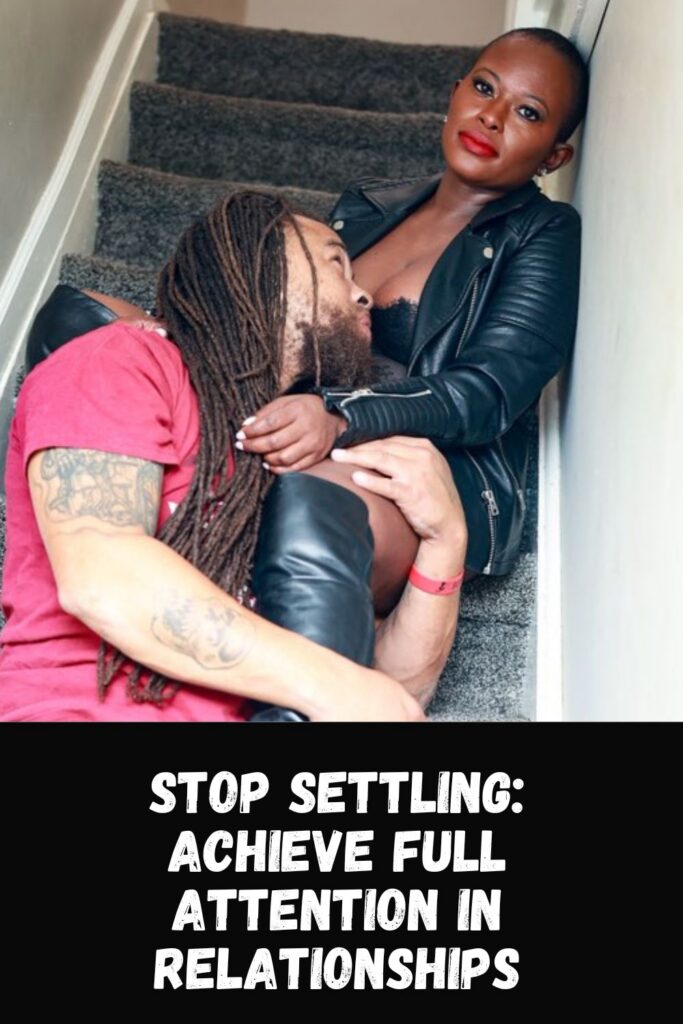
Stop Settling: Achieve Full Attention in Relationships




You Deserve Your Own Full Attention: Rebuilding Your Standard After Settling for Half
This content is shared for storytelling, educational, and entertainment purposes only and is not a substitute for professional counseling or therapy..
There is a particular kind of tired that comes from loving someone at 50% and calling it a relationship. It is not the tired of a bad day. It is the tired of a woman who has spent months, maybe years, quietly negotiating herself down to fit inside someone else’s limitations.
If you read Steps to Choose Yourself Beyond Side Relationships, you already know the internal cost of a hidden or partial relationship: your sense of what you deserve slowly recalibrates downward until halfway starts to look like a full portion. This post is about the rebuild. Not the leaving — the part after, where you actually go about restoring the standard that got worn down.
Companion Post This piece builds on Say Goodbye to Being the Side Chick and Steps to Choose Yourself Beyond Side Relationships. Read those first if this is your first time here.
Your Standard Did Not Disappear. It Got Renegotiated
Nobody wakes up one morning and decides to accept less. It happens in small increments — a canceled plan you let slide, a late-night text you tell yourself means more than it does, a birthday that goes unacknowledged in public because ‘that’s just how it is right now.’ Each one of those moments is a tiny renegotiation. And renegotiations, repeated enough times, become the new contract.
Psychology Today notes that a ‘conflict-free’ relationship can feel safe, but that avoiding friction often really means avoiding vulnerability — and that suppressing your own needs to preserve harmony erodes the very respect a relationship is supposed to run on (Psychology Today). That is worth sitting with, because it means the standard you are trying to rebuild was never really lost. It was traded, piece by piece, for the temporary comfort of not rocking the boat.
Takeaway: Your standard did not vanish — it was quietly negotiated away one small compromise at a time. Which means it can be renegotiated back, the same way: one decision at a time.
Why ‘Knowing Your Worth’ Is Not Enough On Its Own
Every woman who has ever settled for less has, at some point, said the words ‘I know my worth.’ Saying it and living from it are two entirely different disciplines. Knowing your worth is a belief. Rebuilding your standard is a behavior. And behavior is what actually changes the shape of your life.
This is the part that gets skipped in most conversations about self-worth. It is treated like a switch you flip rather than a muscle you rebuild through repetition. The truth is closer to physical therapy than to a light switch — small, unglamorous, repeated motions that slowly restore function to something that has atrophied.
So what does the actual rebuild look like? It looks like naming, out loud, what you are no longer available for. It looks like noticing the gap between what you say you deserve and what you actually tolerate, and closing that gap one decision at a time instead of pretending it does not exist. It looks like letting a silence sit instead of filling it with a text that costs you a piece of your standard.
The Fear Underneath the Settling
Therapist and author Sherry Gaba writes that missing out on early, consistent bonding with a caregiver can leave a person with an outsized fear of abandonment — one that, left unexamined, follows them into adulthood and shows up as relationships with people who are emotionally unavailable, precisely because unavailability feels familiar and therefore survivable (Sherry Gaba, LCSW). That fear is not weakness. It is a survival strategy that made sense once and has simply outlived its usefulness.
Naming that fear does not mean excusing the behavior it produces. It means understanding it well enough to finally interrupt it. You cannot out-discipline a fear you have not identified. You can only manage its symptoms while the root keeps producing the same result.
Takeaway: The fear underneath settling is not about him — it is about an old, unexamined belief that partial love is safer than the risk of asking for everything. Naming it is the first act of rebuilding.
What Rebuilding Actually Sounds Like
Rebuilding your standard is not a mood. It is a set of decisions that repeat until they become identity. Here is what that sounds like in practice, in the actual moments where it counts:
- Saying ‘I need consistency, not just intensity’ — and meaning it enough to walk away from someone who only offers the second.
- Noticing when you are about to explain away a red flag, and choosing to write it down instead of talking yourself out of what you saw.
- Letting a good first date end without inventing a future for someone who has given you no reason to.
- Telling a friend the truth about how you are actually being treated, instead of the version that makes it sound more romantic than it is.
- Choosing boredom with someone stable over chaos with someone exciting, at least long enough to see if the stability has depth underneath it.
None of these moments are dramatic. That is exactly the point. The rebuild is boring by design. Drama is what got you here. Consistency is what gets you out.
Both Sides of the Story
One of the things that makes Sherley’s Show different is that relationship dynamics get examined from both sides. In the Real Talk Series, Sherley and her husband Kalief talk candidly about emotional availability, commitment, and what it actually takes to show up fully for another person — conversations that make it easier to spot the difference between someone who is building toward you and someone who is simply passing time. Find the Real Talk Series at sherleysshow.com/category/podcast/realtalkseries.
Listen: Real Talk Series on Sherley’s Show Candid conversations between Sherley and her husband on emotional availability and what real commitment looks like from both sides. Find it at: sherleysshow.com/category/podcast/realtalkseries
Protecting the Standard Once You Rebuild It
Rebuilding a standard is one thing. Protecting it once it exists is another. This is where The Importance of Self-Preservation in Relationships becomes relevant — because a rebuilt standard without boundaries around it is just a standard waiting to be worn down again by the next person who is convincing enough.
Boundaries are not walls. They are the terms under which you remain open. A standard with no boundary is a wish. A standard with a boundary attached to it is a practice you can actually defend the next time someone tests it — and someone will test it, because the version of you who used to accept less was, in some way, useful to somebody.
Takeaway: A rebuilt standard needs a boundary to protect it, or it will get negotiated down again the first time someone charming enough comes along.
Give the Rebuild Time
One of the fastest ways to sabotage a rebuild is to expect it to feel finished in a few weeks. It will not. There will be nights where the old standard tries to reassert itself — where loneliness makes a familiar kind of partial attention look tempting again. That is not failure. That is the process working exactly as it is supposed to.
Grief has a place here too. You are allowed to miss what a relationship gave you even while acknowledging it was not enough. Those two truths are not in conflict. Rushing past the grief in the name of ‘moving on fast’ usually just delays it, and delayed grief has a way of resurfacing at the worst possible moment — often in the next relationship, aimed at someone who did not create the wound.
Give yourself the same patience you would give a friend rebuilding after a loss, because that is exactly what this is. A loss of time, of energy, and of a version of love that was never going to become what you needed it to be. Patience is not the opposite of progress. It is what makes progress durable instead of temporary.
What Full Attention Actually Looks Like
It helps to get concrete, because ‘full attention’ can sound abstract until you see it laid out next to what you have been settling for. This is not about finding a perfect partner. It is about knowing the difference between someone who is present and someone who is simply around.
| What Partial Attention Looks Like | What Full Attention Looks Like |
| Texts back when it’s convenient for him | Communicates even when life is busy, because you matter enough to make time for |
| Introduces you selectively, or not at all | Wants the people in his life to know you exist |
| Makes plans that can be canceled without explanation | Treats plans with you as commitments, not options |
| Shows up fully only in private | Is consistent whether you are alone or in a room full of people |
| Leaves you guessing where you stand | Tells you where you stand, even when it is inconvenient to say |
Save that table. Read it again on the nights when the memory of someone’s charm is doing more convincing than the actual pattern of their behavior. Charm is not evidence. Consistency is.
The Role of Support in the Rebuild
Nobody rebuilds a standard alone in a vacuum, and you are not meant to. Whether that support looks like a therapist, a counselor, or a coach depends on what you need right now — a distinction covered in depth in Choosing the Right Support: Therapist, Counselor, or Coach. What matters is that you do not try to white-knuckle this alone out of pride or exhaustion. The women who rebuild fastest are not the ones who are the most disciplined. They are the ones who let someone qualified walk alongside them while they do it.
This also means being honest with the people already in your life. Isolation is what allowed the old standard to take root in the first place — nobody was close enough to the situation to reflect back what they were seeing. Rebuilding in the open, with at least one person who has permission to tell you the truth, keeps the process honest.
You Are Not Asking for Too Much
Somewhere along the way, wanting consistency, honesty, and full presence from a partner got recast as ‘high maintenance.’ It is worth saying plainly: full attention from the person who claims to love you is not an extravagant request. It is the baseline. Anything less than that is not a smaller version of love — it is a different thing altogether, wearing love’s language.
You deserve a partner who is not choosing you by process of elimination on a Tuesday night. You deserve someone whose attention does not have competing claims on it. That is not a fantasy standard. That is the standard. The version of you who settled did not do so because the bar was too high. She did so because, for a while, she did not believe she was allowed to hold it.
Key Takeaways
- Your standard was not lost — it was traded away in small, repeated compromises, which means it can be rebuilt the same way, one decision at a time.
- Knowing your worth is a belief. Rebuilding your standard is a behavior. Only the second one changes your life.
- Settling is usually rooted in an old fear of abandonment, not a lack of self-awareness. Naming the fear is what makes it manageable.
- The rebuild looks boring on purpose: consistency, boundaries, and small honest conversations, repeated until they become identity.
- A standard without a boundary around it will get worn down again. Protect what you rebuild.
Go Deeper With Sherley’s Show
If this stirred something in you, here is where to go next on the podcast:
- Real Talk Series — Sherley and her husband on emotional availability and commitment from both sides. sherleysshow.com/category/podcast/realtalkseries
- Conversations — Sherley and Kira on the patterns that keep women stuck. sherleysshow.com/category/podcast/conversation
Subscribe to Sherley’s Show wherever you stream podcasts, and leave a review — it helps more women find the conversations they need.
Final Word
Rebuilding your standard is not about becoming harder to love. It is about becoming harder to underestimate. The woman who requires full attention is not asking the world of anyone — she is simply refusing to accept a fraction of what a real partnership actually offers. You are allowed to want the whole thing. You are allowed to hold out for it. And you are allowed to build the version of yourself that never has to ask twice.
We are rooting for you. We always are.
— Sherley’s Show
Sherley’s Show is learning and growing every single day. We aim to uplift all marginalized voices both on this podcast and in real life. Please note that we are always striving to change the problematic language that society has internalized in us. Thank you for your patience as we aim to strip certain phrases from our vocabulary.
Would you like to be a guest
Are you interested in getting your opinion out about a particular topic but don’t know how to do so? If so, here is an opportunity to do so to share your point of view, PLUS get your message and voice out there. It is always a great way to know about different perspectives and enrich ourselves through knowledge sharing.
Submit your relationship question.
Sherley’s Show provides an atmosphere where every woman is comfortable growing into their best self. Sherley’s Show is a no judgment podcast where we discuss how to rise strong out of all types of obstacles that come with relationships. Through personal life experiences and discussions ranging from infidelity, trust, forgiveness, sex, heartbreak, self love, therapy and more, we offer words of empowerment as you strive to build and maintain all of the relationships in your life. You may be going through something that is unique and difficult. Sharing your story gives others comfort and could also be helping someone else. Let them know they are not alone. Everyone has a story, do not let fear hold you back.
Disclosure: This post contains affiliate links, I will get a commission if you decide to make a purchase through any of my links, at no cost to you. Please read my disclosure for more info.

Want to launch a podcast?
FRee Resource!
Download Sherley’s FREE Bootcamp Podcast Launch Checklist! The no-fluff, step-by-step roadmap for busy women ready to finally launch the podcast they’ve been dreaming about.
At Sherley's Show, we believe that when women feel seen and supported, anything is possible. Whether you're tuning in for inspiration, education, or community—you belong here.



next

say goodbye to being the side chick
When you find yourself really settling with the reality that you are the side chick, when you find yourself tired of the games and/or the complacency, it’s time to ask yourself a few questions.
next

why is therapy important?
Solo therapy, partnered therapy, or group therapy... what exactly are the benefits? If you’re still on the fence about whether or not you should go and if therapy can really do anything for you... this post is for you.
next
CONNECT
elsewhere:

STAY AWHILE AND READ
THE BLOG

BINGE
THE PODCAST
The place where we chat about obstacles that come out of relationships and how to rise up from them. Self-love, marriage, infidelity, sex, heartbreak, and more.

HANG OUT ON

Comments +