
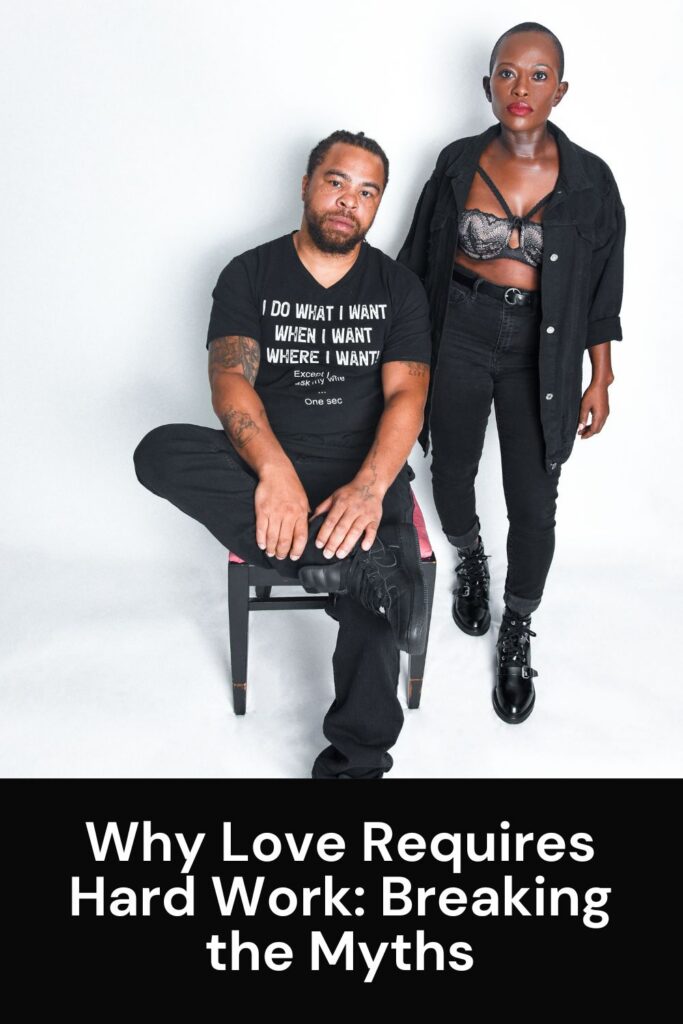
Why Love Requires Hard Work: Breaking the Myths




If You Have to Work at It, Something’s Wrong? That’s a Lie
This content is shared for storytelling, educational, and entertainment purposes only and is not a substitute for professional counseling or therapy.
Somewhere along the way, we got sold a lie. The lie goes like this: if you found the right person, love should feel easy. No friction. No repeating the same fight. No seasons where you look at the person across the table and think, *I do not even know how to talk to you right now.* And the corollary to the lie is even more dangerous: if it *is* hard, you must have picked wrong. So when the hard days come — and they always come — people start eyeing the exit, convinced that struggle itself is the alarm bell.
I am going to say this as plainly as I can, because it is one of the core messages of the entire Real Talk Series: a bad day is not a broken relationship. A bad week is not a broken relationship. Kalief and I have been together nearly thirty years, and we still have hard days. That is not a confession. That is the assignment.
Where the lie comes from
Nobody sat us down and taught us that love should be effortless. We absorbed it. We absorbed it from movies that end at the wedding, as if the wedding is the finish line and not the starting gun. We absorbed it from songs that treat passion like a permanent weather system instead of something you tend. And now we absorb it, hour by hour, from a feed full of couples who look like they have never once raised their voice.
That last source is doing real damage. Research on social comparison has found that the more we measure our own relationships against idealized images online, the worse we tend to feel about what we have — and upward comparison is consistently tied to lower satisfaction and self-esteem. So we are not only carrying a myth, we are getting hourly reinforcement of it from a thousand strangers’ highlight reels. No wonder so many people think their normal, working relationship is secretly failing.
Sixty-nine percent of your problems will never be solved
Here is the statistic that set me free, and I share it on the show all the time. The Gottman Institute, which has studied thousands of couples for decades, found that roughly 69% of the problems couples fight about are perpetual — meaning they are never going to be fully solved. They are rooted in the fundamental differences between two people: personality, upbringing, values, the way you each move through the world. You are not going to fix them. You are going to *manage* them, for the rest of your lives.
Read that again, because it is wild: more than two-thirds of your recurring conflicts are permanent. And here is the part that matters most — happy, lasting couples and miserable, doomed couples have the same percentage of unsolvable problems. The difference is never whether the problems exist. The difference is how you talk about them. Couples who last learn to have an ongoing, respectful dialogue about their perpetual issues. Couples who fall apart get gridlocked, dig in, and start to see each other as the enemy.
Do you understand what that means for the lie? If even the best relationships are full of problems that never go away, then the presence of struggle tells you absolutely nothing about whether your relationship is good. Struggle is the baseline. It is the price of admission for two whole humans sharing a life.
I cannot tell you how much pressure this one fact takes off a relationship. So many people are quietly grading their marriage on a curve it was never going to meet — expecting a level of ease that no real partnership, anywhere, has ever sustained. When you finally accept that the conflict is not going anywhere and was never supposed to, you can stop pouring energy into being upset that problems exist and start pouring it into the only thing that actually helps: how you treat each other while you carry them.
Hard is normal. Now let me draw a line.
I never want this message to be twisted, so let me be careful here. “Hard days are normal” is not the same as “stay no matter what.” There is an enormous difference between *hard* and *harmful*. Hard is the recurring fight about money or in-laws or how you each handle stress. Hard is a dry season where the spark is low and you have to consciously turn back toward each other. Harmful is contempt, abuse, fear, a pattern that diminishes you. One is the normal weather of a long relationship. The other is a reason to get yourself safe.
So when I say do not run at the first sign of difficulty, I am talking about difficulty — not danger. If you are trying to figure out which one you are in, I have talked about exactly that in How To Know If The Relationship Is Over. Leaving a relationship that has become harmful is not failure; it can be the most courageous thing a person does. The myth I am dismantling is the smaller, sneakier one: the belief that ordinary, workable struggle means you are doomed.
The “what if it could be easier with someone else” trap
The lie has a favorite cousin, and it whispers during the dry seasons: *what if it would just be easier with someone else?* It is a seductive thought because it is technically true — the beginning with someone new is always easier. There are no perpetual problems yet because you have not been around long enough to find them. Give it three years and the new person will have their own 69%.
I dig into this directly in Navigating Long-Term Relationships: The ‘What If’ Dilemma, because that fantasy has ended a lot of relationships that were not actually broken — just hard, at the moment, the way every long relationship periodically is. The grass is not greener. The grass is greener where you water it, and watering is work. The fantasy is selling you the idea that the right relationship would not need watering at all. There is no such relationship. There never has been.
What working at it actually looks like
When people hear “you have to work at it,” they picture misery — some grim slog of compromise and gritted teeth. That is not what it is. Working at it is mostly small and unglamorous. It is choosing to repair after a fight instead of letting the silence calcify. It is learning your partner’s communication style so the same misunderstanding stops happening on a loop. It is turning toward each other in the tiny daily moments instead of away. It is going to therapy before you are in crisis, not after.
And it is continuous. The communication that worked for Kalief and me in year five does not work in year twenty-nine, because we are not the same people we were in year five. The work is not a project you complete. It is a practice you keep. The good news — the genuinely hopeful news buried inside that 69% — is that you do not have to solve your hardest problems to have a thriving relationship. You only have to keep talking about them without contempt. That is doable. That is within reach on a random Tuesday when you would rather not.
Shame is why people suffer in silence
The cruelest part of the “love should be easy” lie is what it does in the dark. People do not just leave relationships because they are hard — plenty of them stay and suffer silently, too ashamed to admit they are struggling, because everyone around them seems to have it figured out. They scroll the highlight reels, they hear nobody else complaining, and they conclude that their normal difficulty is a uniquely shameful secret. So they say nothing. And the silence makes them feel even more alone, which makes the struggle feel even more like proof that something is wrong with them specifically.
This is the exact isolation the Real Talk Series was built to break. When Kalief and I say out loud that we have hard days, that we have hurt each other, that we have had the same fight more times than I can count — something in a listener exhales. *Oh. It is not just me.* That exhale is the whole point. Shame cannot survive being spoken honestly in a room where someone says “me too.” The lie thrives on silence. The truth needs a witness.
Hard seasons are seasons — they pass
Something the effortless-love myth never accounts for is that long relationships move through seasons. There are stretches where everything flows and stretches where it is genuinely heavy — a hard year at work, grief, a health scare, small kids, a stretch where the spark is just low for reasons neither of you can fully name. In the moment, a heavy season can feel permanent, like this is just who you are now. It is almost never permanent. It is weather.
Intimacy shifts. Priorities shift. The people you are at thirty are not the people you are at fifty, and a relationship that lasts is one where you let the seasons be seasons instead of treating every dry spell as a referendum on the whole thing. Kalief and I have been through seasons I genuinely was not sure we would come out of — and we came out. Not because we are special, but because we did not mistake a hard chapter for the end of the book. If you are in a heavy season right now, that alone is not your answer. Give it the patience you would give the weather.
The most freeing sentence I know
If I could staple one idea to the inside of everyone’s forehead, it would be this: the question is not whether your relationship is hard. The question is whether you are both willing to do the work, on the hard days, as a team. That reframe takes all the panic out of difficulty. A rough patch stops being evidence that you failed and starts being just… a rough patch. A season. Weather, not climate.
Kalief and I are not still together because we found some magic combination that made love easy. We are still together because we stopped believing it was supposed to be. The day you let go of the lie is the day your real relationship gets to stop competing with an imaginary one. And that real relationship — hard days and all — turns out to be the one worth keeping.
Key Takeaways
- The belief that real love should feel effortless is a myth — and it pushes people to abandon relationships that are normal, not broken.
- Gottman Institute research found about 69% of relationship problems are perpetual and never fully solved — in happy and unhappy couples alike.
- What separates lasting couples is not the absence of problems but the ability to keep talking about them without contempt or gridlock.
- “Hard” and “harmful” are not the same. Ordinary struggle is normal; abuse, contempt, and fear are reasons to get safe.
- The “it would be easier with someone else” fantasy ignores that every new relationship eventually grows its own unsolvable problems.
- Working at it is mostly small and daily: repairing after fights, learning each other’s communication, turning toward each other on purpose.
Frequently Asked Questions
Is it normal for relationships to be hard?
Yes. Gottman Institute research found about 69% of the problems couples fight about are perpetual and never fully solved — in happy and unhappy couples alike. Ongoing struggle is the baseline of long-term love, not a sign your relationship is broken.
Does working at a relationship mean something is wrong?
No. The belief that real love should feel effortless is a myth. Every lasting relationship takes ongoing effort, so needing to work at it is normal — not a red flag.
How do I know if my relationship is just hard or actually unhealthy?
There is a real difference between hard and harmful. Hard is recurring conflict and dry seasons; harmful is contempt, fear, or abuse. If you are trying to tell the difference, Sherley’s perspective on knowing when a relationship is over can help.
Would it really be easier with someone else?
Usually not. Every new relationship eventually grows its own unsolvable problems. The grass is greener where you water it — the fantasy that the right relationship needs no work does not match reality.
Sources & Further Reading
From Sherley’s Show (related reading on sherleysshow.com):
- Unfiltered Love: The Real Talk Series by Sherley’s Show
- How To Know If The Relationship Is Over
- Navigating Long-Term Relationships: The ‘What If’ Dilemma
- Mastering Communication: Styles That Shape Your Relationships
- All Real Talk Series episodes
- Submit your story — Listener Stories
Research & external sources cited:
- The Gottman Institute — Managing Conflict: Solvable vs. Perpetual Problems (the 69% finding)
- Psychology Today — Why 69% of a Couple’s Conflict Will Never Go Away
- Frontiers in Psychology — Upward social comparison and lower satisfaction and self-esteem
Listen to the Real Talk Series on Sherley’s Show
If you have been quietly wondering whether your relationship is failing just because it is hard, the Real Talk Series was made for you. Kalief and I show up every month to talk about the unglamorous, ongoing work of staying — honestly, and without pretending we have it all figured out.
Find the Real Talk Series episodes here, wherever you listen. And if you are sitting in a hard season and want to talk it through, submit your story or question on the Listener Stories page — someone else needs to hear they are not the only one.
Be Yourself. Voice Yourself. Love Yourself.
Sherley’s Show is learning and growing every single day. We aim to uplift all marginalized voices both on this podcast and in real life. Please note that we are always striving to change the problematic language that society has internalized in us. Thank you for your patience as we aim to strip certain phrases from our vocabulary.
Would you like to be a guest
Are you interested in getting your opinion out about a particular topic but don’t know how to do so? If so, here is an opportunity to do so to share your point of view, PLUS get your message and voice out there. It is always a great way to know about different perspectives and enrich ourselves through knowledge sharing.
Submit your relationship question.
Sherley’s Show provides an atmosphere where every woman is comfortable growing into their best self. Sherley’s Show is a no judgment podcast where we discuss how to rise strong out of all types of obstacles that come with relationships. Through personal life experiences and discussions ranging from infidelity, trust, forgiveness, sex, heartbreak, self love, therapy and more, we offer words of empowerment as you strive to build and maintain all of the relationships in your life. You may be going through something that is unique and difficult. Sharing your story gives others comfort and could also be helping someone else. Let them know they are not alone. Everyone has a story, do not let fear hold you back.
Disclosure: This post contains affiliate links, I will get a commission if you decide to make a purchase through any of my links, at no cost to you. Please read my disclosure for more info.

Want to launch a podcast?
FRee Resource!
Download Sherley’s FREE Bootcamp Podcast Launch Checklist! The no-fluff, step-by-step roadmap for busy women ready to finally launch the podcast they’ve been dreaming about.
At Sherley's Show, we believe that when women feel seen and supported, anything is possible. Whether you're tuning in for inspiration, education, or community—you belong here.



next

say goodbye to being the side chick
When you find yourself really settling with the reality that you are the side chick, when you find yourself tired of the games and/or the complacency, it’s time to ask yourself a few questions.
next

why is therapy important?
Solo therapy, partnered therapy, or group therapy... what exactly are the benefits? If you’re still on the fence about whether or not you should go and if therapy can really do anything for you... this post is for you.
next
CONNECT
elsewhere:

STAY AWHILE AND READ
THE BLOG

BINGE
THE PODCAST
The place where we chat about obstacles that come out of relationships and how to rise up from them. Self-love, marriage, infidelity, sex, heartbreak, and more.

HANG OUT ON

Comments +