
Understanding the 2% Rule in Relationships




The 2% Rule: Why We Only Share a Sliver of Our Relationship Online
This content is shared for storytelling, educational, and entertainment purposes only and is not a substitute for professional counseling or therapy.
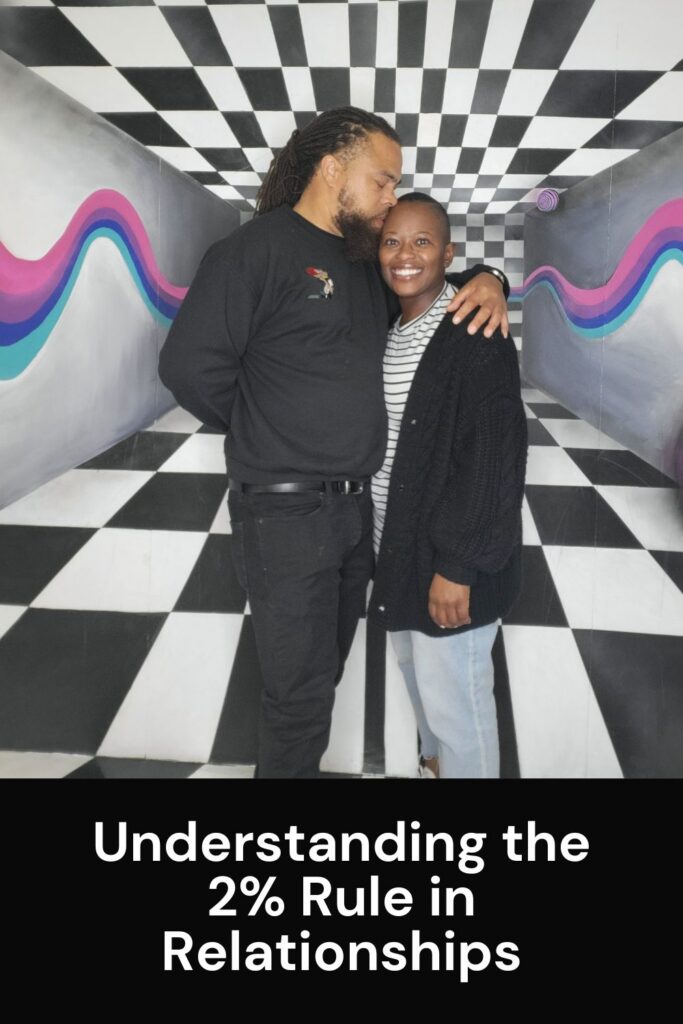
There is a number I bring up on the Real Talk Series more than almost anything else, and it surprises people every single time. Kalief and I have been together for nearly thirty years, and we share about two percent of that publicly. Two percent. Not because we are hiding something. Not because the rest is ugly. But because two percent is exactly how much of our relationship belongs to you — and ninety-eight percent belongs to us.
I call it the two percent rule, and it is one of the founding ideas behind the whole Real Talk Series. If you have ever scrolled past a couple’s anniversary post and felt that quiet little ache — *why doesn’t mine look like that?* — this one is for you. Because the answer is almost always that you are comparing your behind-the-scenes to somebody else’s two percent.
The highlight reel was never the whole story
Here is what people post: the trip, the matching outfits, the caption that makes a fifteen-year marriage sound like a perfume commercial. Here is what they do not post: the argument they had in the car on the way to the photo, the season they barely spoke, the year they went to counseling. None of that makes it to the grid. And there is nothing wrong with that — nobody owes the internet their lowest moments. The problem is what happens on the *other* end of the screen, when you forget that everyone is doing the same thing.
We are wired to compare, and social media gives us an endless feed of other people’s best two percent to measure ourselves against. The research backs this up: studies on social comparison have found that scrolling through curated relationship content can quietly shape how satisfied we feel with our own partnerships, and that comparing upward — against people who seem to have it better — is linked to lower self-esteem and life satisfaction. One study on relationship social comparisons found that simply viewing an idealized couple online can affect how a person feels about their own relationship and their own well-being. You are not weak for feeling that ache. You are human, and the machine is built to produce it.
What “two percent” actually means
When I say we share two percent, I do not mean we share a fake version. Everything we put out on the Real Talk Series is true. It happened. It is real. But it is *chosen.* I decide what gets a microphone and what stays at my kitchen table, and that choosing is not dishonesty — it is editing. Every honest storyteller edits. A memoir is true and still leaves things out. A documentary is real and still ends up on the cutting-room floor more than it keeps.
So the two percent is the part of our story that has something to offer you. The lesson we learned the hard way. The fight that taught us something about ourselves. The infidelity we have talked about openly because somebody out there needs to know they are not the only one. That is the two percent. The other ninety-eight — the inside jokes, the ordinary Tuesdays, the private repair work, the things that are nobody’s business — that is ours to keep. And keeping it is not a flaw in the sharing. It is the whole point.
Curated is not the same as fake
I want to sit here for a second because this is where people get tripped up. “Curated” has become a dirty word. We use it to mean phony, staged, performative. But curating just means you made a decision about what to show. A museum curator is not lying to you by leaving paintings in storage — they are making choices about what serves the room. You get to be the curator of your own life, and that is not the opposite of authentic. It is what mature authenticity looks like.
Fake is posting a soft-focus photo and pretending the relationship is effortless when you are quietly falling apart. Curated is telling a true story and choosing, on purpose, where it ends. One of those misleads people. The other respects both you and them. On the Real Talk Series I can tell you about a hard season Kalief and I walked through and still not hand you a transcript of every word we said behind closed doors. Both things are true at once: I am being real with you, *and* I am keeping most of it private.
Boundaries are an act of self-respect, not secrecy
Brené Brown has spent years studying vulnerability, and one of the most useful things she has said is that vulnerability is not the same as oversharing. Real vulnerability, she argues, comes with boundaries and trust — it means sharing your story with people who have earned the right to hear it, not dumping it on everyone within reach. She makes the point that boundaryless disclosure is actually a way we *avoid* true vulnerability, not a sign of it.
That reframed everything for me. For a long time I think a lot of us believed that being “open” meant holding nothing back — that privacy was a kind of dishonesty. It is not. Choosing what stays sacred is a form of respect: for your partner, for your relationship, and for yourself. When Kalief and I decide together that something is not for the show, we are not being secretive. We are protecting the thing that makes the sharing possible in the first place. You cannot pour from a relationship you have given entirely away to strangers.
The comparison trap, and how the 2% rule gets you out of it
Once you understand that everyone is showing you their two percent, the comparison game starts to lose its grip. That couple whose marriage looks flawless? You are seeing their two percent. The influencer whose partner surprises her with flowers on camera? Two percent. Your own relationship, the one you know inside and out, all the boredom and tension and tenderness of it? You are living in the full hundred. Of course it feels heavier. You are comparing a whole life to a slideshow.
This is the same trap I talk about in Common-Sense Love: Balancing Trust and Reality in Relationships. When we measure our reality against everyone else’s edited highlights, we end up distrusting something that is actually fine, or chasing a version of love that does not exist anywhere except a caption. The two percent rule is the antidote: assume you are always seeing the trailer, never the movie, and give your own relationship the grace of being judged on its whole self instead of someone else’s clip.
What we choose not to share — and why
People sometimes assume that because Kalief and I have talked openly about hard things, including infidelity, we must share everything. We do not, and the line is deliberate. We do not narrate our active disagreements in real time. We do not turn our son’s and daughter’s lives into content. We do not use the platform to win an argument with each other. And we never share something that is genuinely Kalief’s alone to tell, or mine alone, without both of us agreeing it should go out.
That last one matters. A relationship is shared property, and so is its story. One person should not be able to publish the other. We treat our public story the way we try to treat the pillars of the relationship itself — as something built together, on agreement, not something one of us imposes on the other. If Kalief is not comfortable, it does not go out. Full stop. That is also, frankly, part of the leadership and partnership we talk about — deciding together what the world gets to see.
How to share your story and keep yourself
Maybe you are not running a podcast, but you are deciding how much of your love life to put online, how much to tell your group chat, how much to reveal at the family dinner table. The two percent rule works there too. You can be the kind of person who is real and warm and honest — the kind people feel safe around — without being an open book that anyone can read. Decide, on purpose, what you are sharing and why. Ask whether it serves the person hearing it or just feeds the need to be seen. Ask whether your partner would feel respected if they saw it.
This is the same energy I talk about with younger folks trying to date with intention in Building Genuine Connections in 2025 Dating Culture. Genuine connection does not require total exposure. It requires honesty with boundaries. You can let people see you clearly and still keep a private interior life that belongs only to you and the person you love.
The pressure to perform your relationship
There is a quiet pressure now to *perform* your relationship in public — to post the anniversary, to do the soft launch, to prove the love is real by documenting it. And when you do not, people read meaning into the silence. *Are they okay? Why doesn’t she ever post him?* I have felt that pressure, and I want to name it for what it is: a trap. The health of a relationship has never once been measurable by its posting frequency. Some of the strongest couples I know are nearly invisible online. Some of the ones who posted the most are no longer together.
If you find yourself posting your relationship to prove something — to an ex, to your followers, to that voice in your head that compares — pause. The two percent rule is also a permission slip to opt out of the performance entirely. You do not owe anyone proof of your love. You do not have to feed the algorithm your marriage to validate it. The relationship is real because you are living it, not because you are broadcasting it. That is a freedom most people forget they have.
Protecting the relationship from the audience
Here is something I had to learn the hard way once the platform grew: the audience can start to shape the relationship if you let it. When you share a lot, you begin — even subconsciously — to live partly for the telling. You catch yourself narrating a moment in your head instead of being in it. You start making choices with one eye on how they will read. That is the moment sharing stops serving the relationship and starts quietly distorting it.
The two percent rule protects against that. By keeping the vast majority of our life off the record, Kalief and I make sure the relationship is always the main thing and the content is always the byproduct — never the other way around. The marriage is not material. It is the actual life, and the actual life has to stay bigger than anything we ever say about it on a microphone. When you guard that order — life first, story second — you protect the very thing people tune in for. The realness only survives if most of it stays unshared.
The freedom on the other side of it
Here is what nobody tells you: the two percent rule is freeing. When you stop performing the other ninety-eight percent, you stop having to maintain a version of your relationship for an audience. You get to just *have* the relationship. The private moments stay private and therefore stay precious. The public moments stay honest because you are not stretching the truth to fill a feed. And the gap between what you show and what you live stops being a source of shame, because you decided that gap on purpose.
Two percent is not a limit on honesty. It is the shape honesty takes when it has self-respect. That is what Kalief and I are doing every time we sit down at the mic — handing you the part of our story that might help, and keeping the rest, gladly, for ourselves.
Key Takeaways
- Almost everything you see online is someone’s curated two percent — comparing your full reality to it is a setup for feeling inadequate.
- Curated is not the same as fake. Choosing what to share is editing, not dishonesty, as long as what you do share is true.
- Research on social comparison links scrolling idealized relationship content to lower self-esteem, satisfaction, and well-being.
- Boundaries around what you share are an act of self-respect. As Brené Brown puts it, vulnerability without boundaries is not vulnerability at all.
- A relationship’s story is shared property — decide together what goes public, and let either partner keep something private.
- You can be honest, warm, and real without being an open book. The 2% rule lets you share your story and still keep yourself.
Frequently Asked Questions
What is the 2% rule in relationships?
The 2% rule means sharing only a small, chosen portion of your relationship publicly while keeping the rest private. On the Real Talk Series, Sherley and Kalief share roughly two percent of their nearly thirty years together — real, but curated — and keep the other ninety-eight percent for themselves.
Is it healthy to keep your relationship private on social media?
Yes. Privacy is not the same as secrecy. Choosing what stays off the internet is an act of self-respect and a boundary that protects the relationship — not a sign that anything is wrong. You do not owe anyone proof of your love.
Why do other couples’ relationships look perfect online?
Because you are seeing their curated highlights, not their full reality. Research on social comparison shows that measuring your own relationship against idealized posts is linked to lower satisfaction and self-esteem.
Does sharing less make you less authentic?
No. Curating what you share is editing, not lying — as long as what you do share is true. You can be honest, warm, and real while keeping a private life that belongs only to you and your partner.
Sources & Further Reading
From Sherley’s Show (related reading on sherleysshow.com):
- Unfiltered Love: The Real Talk Series by Sherley’s Show
- 6 Essential Pillars for Lasting Relationships
- The Role of Leadership and Submission in Healthy Relationships
- Common-Sense Love: Balancing Trust and Reality in Relationships
- Building Genuine Connections in 2025 Dating Culture
- All Real Talk Series episodes
- Submit your story — Listener Stories
Research & external sources cited:
- Frontiers in Psychology — Upward social comparison and its link to lower self-esteem and life satisfaction
- Personality and Individual Differences (via ScienceDirect) — Relationship social comparisons: how viewing others online affects your own relationship and well-being
- Brené Brown, Daring Greatly (via Oprah.com) — Vulnerability is not oversharing — sharing with people who have earned it
Listen to the Real Talk Series on Sherley’s Show
Kalief and I get into the two percent rule — and a whole lot more of what long-term love actually looks like — every month on the Real Talk Series. If this gave you language for something you have felt but could not name, the conversations go deeper.
Start with the Real Talk Series episodes here, wherever you listen to podcasts. And if you have a story about comparison, privacy, or where you draw your own line — something you have never heard talked about honestly — share it with us on the Listener Stories page. Your voice belongs in this conversation. Be Yourself. Voice Yourself. Love Yourself.
Sherley’s Show is learning and growing every single day. We aim to uplift all marginalized voices both on this podcast and in real life. Please note that we are always striving to change the problematic language that society has internalized in us. Thank you for your patience as we aim to strip certain phrases from our vocabulary.
Would you like to be a guest
Are you interested in getting your opinion out about a particular topic but don’t know how to do so? If so, here is an opportunity to do so to share your point of view, PLUS get your message and voice out there. It is always a great way to know about different perspectives and enrich ourselves through knowledge sharing.
Submit your relationship question.
Sherley’s Show provides an atmosphere where every woman is comfortable growing into their best self. Sherley’s Show is a no judgment podcast where we discuss how to rise strong out of all types of obstacles that come with relationships. Through personal life experiences and discussions ranging from infidelity, trust, forgiveness, sex, heartbreak, self love, therapy and more, we offer words of empowerment as you strive to build and maintain all of the relationships in your life. You may be going through something that is unique and difficult. Sharing your story gives others comfort and could also be helping someone else. Let them know they are not alone. Everyone has a story, do not let fear hold you back.
Disclosure: This post contains affiliate links, I will get a commission if you decide to make a purchase through any of my links, at no cost to you. Please read my disclosure for more info.

Want to launch a podcast?
FRee Resource!
Download Sherley’s FREE Bootcamp Podcast Launch Checklist! The no-fluff, step-by-step roadmap for busy women ready to finally launch the podcast they’ve been dreaming about.
At Sherley's Show, we believe that when women feel seen and supported, anything is possible. Whether you're tuning in for inspiration, education, or community—you belong here.



next

say goodbye to being the side chick
When you find yourself really settling with the reality that you are the side chick, when you find yourself tired of the games and/or the complacency, it’s time to ask yourself a few questions.
next

why is therapy important?
Solo therapy, partnered therapy, or group therapy... what exactly are the benefits? If you’re still on the fence about whether or not you should go and if therapy can really do anything for you... this post is for you.
next
CONNECT
elsewhere:
STAY AWHILE AND READ
THE BLOG

BINGE
THE PODCAST
The place where we chat about obstacles that come out of relationships and how to rise up from them. Self-love, marriage, infidelity, sex, heartbreak, and more.

HANG OUT ON

Comments +