
Batch Recording: The Secret to Sustainable Podcasting




Batch Recording and Editing: The Workflow That Actually Prevents Podfade
Disclaimer: Sherley Troutman is not a licensed business, financial, or legal advisor. The content in this article is for informational and educational purposes only, based on her personal experience coaching women through podcast launches and general industry research. Please consult a qualified professional for advice specific to your business.
Podfade — the slow, quiet death of a podcast where episodes just stop coming — rarely happens because a host runs out of things to say. It happens because recording and editing one episode at a time, reactively, week after week, is an exhausting way to run a show, and exhaustion eventually wins. Batching is the single biggest structural fix I recommend to almost every woman I coach, regardless of what her show is about, because it solves the actual mechanism behind podfade rather than just the symptom.
If you’ve read our piece on stopping podfade, you already know consistency is the system-level problem. This article goes one layer deeper into the specific workflow — batch recording and batch editing — that makes consistency actually sustainable instead of something you’re white-knuckling through every single week.
I want to be honest that batching isn’t a magic fix that removes all effort. The total amount of work to produce a month of episodes doesn’t shrink dramatically just because you batch it. What changes is when that work happens, and how much of it depends on your energy and motivation being available at exactly the right weekly moment. That shift alone is often the difference between a show that survives its first year and one that quietly stops.
What Batching Actually Means
Batching means recording multiple episodes in a single, focused session rather than one episode per sitting. Instead of setting up your mic, finding your headspace, and recording once a week, you block out a longer session — say, three or four hours — and record three to six episodes back to back. The setup cost happens once. The mental transition into “recording mode” happens once. What used to require getting yourself into the right headspace weekly now only requires it monthly, or even quarterly.
The same logic extends to editing. Rather than editing each episode the moment it’s recorded, batching means setting aside a separate block of time to edit everything from that recording session at once, using the same settings, the same intro/outro placement, the same workflow, repeated efficiently rather than relearned from scratch each time.
It’s worth noting these are two separate batches, not one combined marathon. Trying to record and edit in the same extended session tends to produce worse results at both — your voice and energy are better suited to recording earlier in a session, and editing benefits from a slightly more removed, critical-listening mindset that’s hard to access right after you’ve just finished talking for hours.

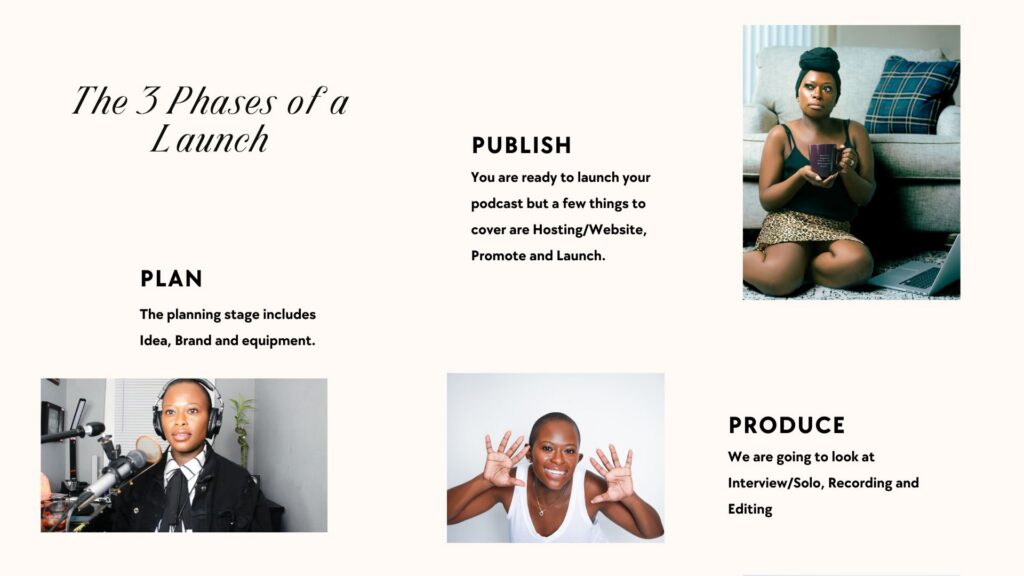
Grab the checklist featured above → Free checklist
Or see all free resources → Free Resources
Why This Solves the Consistency Problem
The reason batching works isn’t just efficiency — it’s that it removes the weekly decision point entirely. A podcast that requires you to decide, every single week, whether you have the energy to record right now is a podcast that’s one bad week away from a missed episode. A podcast where four episodes are already recorded and sitting in the queue can absorb a bad week without missing a beat, because the buffer is already built.
This buffer is the actual mechanism behind consistency, more than willpower or motivation ever will be. Motivation is unreliable by nature — it comes and goes with your mood, your energy, your week. A recorded backlog doesn’t care about your mood. It’s already done. Batching converts an ongoing weekly obligation into a periodic one, which is a fundamentally easier thing to sustain.
This matters especially for career women balancing a podcast alongside full-time work, because the weeks most likely to derail a podcast — a demanding stretch at work, travel, a family emergency — are exactly the weeks a buffer is built to absorb. Without one, a single hard week becomes a missed episode. With one, it barely registers on the publishing schedule.
How Often to Batch, Realistically
There’s no single right cadence, but a useful starting point for most independent podcasters is a monthly batch session that covers four to five episodes — enough to cover a full month of weekly publishing with a small buffer left over. Some hosts prefer quarterly batching, recording ten to twelve episodes in a single intensive stretch a few times a year. The right cadence depends on your schedule’s natural rhythm more than any universal rule — a woman with unpredictable travel might prefer larger, less frequent batches; a woman with a steady weekly schedule might do fine with smaller, more frequent ones.
The one pattern worth avoiding regardless of cadence is batching too close to your buffer running out. If you only batch again once you’re down to your last unpublished episode, you’ve recreated the exact weekly pressure batching was supposed to eliminate. Building the next batch session while you still have two or three episodes of runway left keeps the system genuinely ahead of you instead of chasing you.
A flight attendant’s schedule, for instance, tends to fit quarterly batching better than monthly — long, irregular trip blocks make a predictable monthly session harder to guarantee, but a bigger quarterly push during a stretch of home time can build a runway that survives the more unpredictable months in between. There’s no wrong answer here as long as the cadence matches your actual life rather than an idealized one.
Preparing for a Batch Recording Session
The single biggest lever for a smooth batch session is preparation done in advance, not during. Outline every episode you plan to record before the session starts — topics, key points, any guest information — so the session itself is pure execution rather than half-planning, half-recording. Trying to figure out what an episode is about while you’re also trying to record it is where batch sessions run long and lose energy halfway through.
It also helps to sequence episodes by energy level rather than randomly. Record your highest-energy, most demanding topics first, while you’re fresh, and save lighter, more conversational episodes for later in the session when your energy naturally dips. A four-hour block where the hardest work happens in hour one tends to produce better episodes across the board than one where energy and difficulty are mismatched.
Small logistical details compound over a longer session in ways they wouldn’t in a single-episode recording: water within reach, a voice warm-up before hitting record, a five-minute break between every second or third episode to reset your voice and your energy. None of this is complicated, but skipping it is the most common reason a promising batch session produces noticeably weaker episodes toward the end.
Building an Efficient Editing Workflow
Editing is where batching pays off the most, because repetition builds real speed. The first episode you edit in a batch will likely take the longest. By the third or fourth, you’ll have found a rhythm — the same noise reduction settings, the same intro/outro drop-in points, the same process for trimming dead air — and each subsequent episode gets noticeably faster to finish.
A template-based approach makes this even more efficient. Building a project template in your editing software with your intro, outro, standard EQ settings, and any recurring segments already placed means each new episode starts from a working structure rather than a blank project. This is a one-time setup cost that pays back on every single episode afterward.
If editing is consistently the bottleneck even with batching and templates in place, outsourcing that specific piece is often the highest-leverage delegation move available to a solo podcaster — more so than outsourcing recording or planning, since editing is the most mechanically repetitive and most time-intensive part of the process for most hosts. A freelance editor working from your established template can often turn around a batch faster and more consistently than a solo host squeezing editing into evenings between everything else.
What to Track So Batching Actually Sticks
A simple content calendar showing which episodes are recorded, which are edited, and which are scheduled to publish is enough to keep a batching system honest. Without visibility into your buffer, it’s easy to accidentally let it shrink without noticing until you’re back in reactive, weekly-pressure mode. A glance at the calendar should tell you, at any moment, exactly how much runway you have left and when your next batch session needs to happen.
Batching isn’t a one-time fix you set up once and forget. It’s a rhythm that needs periodic maintenance — a recurring calendar block for the next session, a habit of topic-brainstorming between batches so you’re never starting the next planning phase from zero. Treat it as infrastructure for the show, not a trick you used once to get ahead.
The women who sustain a podcast for years, rather than months, are rarely the ones with the most free time or the most natural discipline. They’re the ones who built a system that doesn’t depend on either. Batching is the most reliable version of that system I’ve seen work across every kind of schedule, every kind of show, and every kind of host — which is exactly why it’s the first structural change I recommend when a woman tells me she’s worried about keeping up.
Key Takeaways
✓ Batching means recording and editing multiple episodes in a single focused session instead of one episode per sitting.
✓ The real value of batching is removing the weekly decision point — a recorded buffer absorbs a bad week without breaking your publishing schedule.
✓ Monthly or quarterly batch sessions both work; the right cadence depends on your schedule’s natural rhythm, not a universal rule.
✓ Outlining every episode before the session, and sequencing by energy level, prevents batch sessions from running long or losing momentum.
✓ A simple content calendar tracking recorded, edited, and scheduled episodes keeps your buffer visible so batching doesn’t quietly erode.
Related Reading & Resources
→ Stop Podfade: Key Systems Every Podcaster Needs
→ Investing in Podcast Gear: Smart Choices for Beginners
→ How to Turn a Podcast Episode into 20+ Content Pieces
→ 90-Day Podcast Launch: What to Expect
→ Browse More Business Articles
Be Yourself. Voice Yourself. Love Yourself.

Sherley’s Show is learning and growing every single day. We aim to uplift all marginalized voices both on this podcast and in real life. Please note that we are always striving to change the problematic language that society has internalized in us. Thank you for your patience as we aim to strip certain phrases from our vocabulary.
Would you like to be a guest
Are you interested in getting your opinion out about a particular topic but don’t know how to do so? If so, here is an opportunity to do so to share your point of view, PLUS get your message and voice out there. It is always a great way to know about different perspectives and enrich ourselves through knowledge sharing.
Submit your relationship question.
Sherley’s Show provides an atmosphere where every woman is comfortable growing into their best self. Sherley’s Show is a no judgment podcast where we discuss how to rise strong out of all types of obstacles that come with relationships. Through personal life experiences and discussions ranging from infidelity, trust, forgiveness, sex, heartbreak, self love, therapy and more, we offer words of empowerment as you strive to build and maintain all of the relationships in your life. You may be going through something that is unique and difficult. Sharing your story gives others comfort and could also be helping someone else. Let them know they are not alone. Everyone has a story, do not let fear hold you back.
Disclosure: This post contains affiliate links, I will get a commission if you decide to make a purchase through any of my links, at no cost to you. Please read my disclosure for more info.

Want to launch a podcast?
FRee Resource!
Download Sherley’s FREE Bootcamp Podcast Launch Checklist! The no-fluff, step-by-step roadmap for busy women ready to finally launch the podcast they’ve been dreaming about.
At Sherley's Show, we believe that when women feel seen and supported, anything is possible. Whether you're tuning in for inspiration, education, or community—you belong here.



next

say goodbye to being the side chick
When you find yourself really settling with the reality that you are the side chick, when you find yourself tired of the games and/or the complacency, it’s time to ask yourself a few questions.
next

why is therapy important?
Solo therapy, partnered therapy, or group therapy... what exactly are the benefits? If you’re still on the fence about whether or not you should go and if therapy can really do anything for you... this post is for you.
next
CONNECT
elsewhere:

STAY AWHILE AND READ
THE BLOG

BINGE
THE PODCAST
The place where we chat about obstacles that come out of relationships and how to rise up from them. Self-love, marriage, infidelity, sex, heartbreak, and more.

HANG OUT ON

Comments +