
FastTrack: Unlocking the Five Pillars for Podcast Success




How FastTrack Puts the Trauma-to-Profit™ Methodology Into Practice
Disclaimer: Sherley Troutman is not a licensed business consultant, attorney, therapist, or financial advisor. The content in this article is for informational and educational purposes only, based on her personal experience building the Trauma-to-Profit™ Methodology and FastTrack. Please consult a qualified professional for advice specific to your business or personal circumstances.
If you’ve spent any time on this blog, you already know the Trauma-to-Profit™ Methodology — Recognize, Release, Rebuild, Reframe, Revenue. Five pillars that take a woman from carrying an experience privately to building something public out of it. What isn’t always obvious from the explainer posts is how those five pillars actually function inside a real program. They aren’t just a framework I reference in captions. They’re the literal architecture FastTrack is built on, week by week. This is the article that connects those two dots directly.
I built it this way on purpose. It would have been easier to build FastTrack as a generic “how to launch a podcast” curriculum and mention T2P as a nice-sounding tagline somewhere on the sales page. Instead, the methodology came first, and the curriculum is what happens when you ask what a podcast launch looks like if you take each of those five pillars seriously as a real phase of work rather than a slogan.
Why This Distinction Matters
T2P is platform-agnostic on purpose — it applies whether you’re building a podcast, a speaking career, a coaching practice, or a social presence. FastTrack is what happens when I take that same methodology and apply it specifically to a 90-day podcast launch. So when people ask whether FastTrack is “a different thing” from T2P, the honest answer is no — FastTrack is T2P with a very specific container and a very specific outcome attached to it. Understanding the five pillars is understanding why FastTrack is sequenced the way it is, not just what happens in each week.
This also explains something that confuses a few applicants early on: why FastTrack doesn’t open with a module called “podcast basics.” It opens with the same starting point every T2P journey starts with, because a podcast launch that skips the internal work tends to produce a technically fine show with no real center to it. The pillars aren’t decoration layered onto a podcasting curriculum after the fact. They came first.
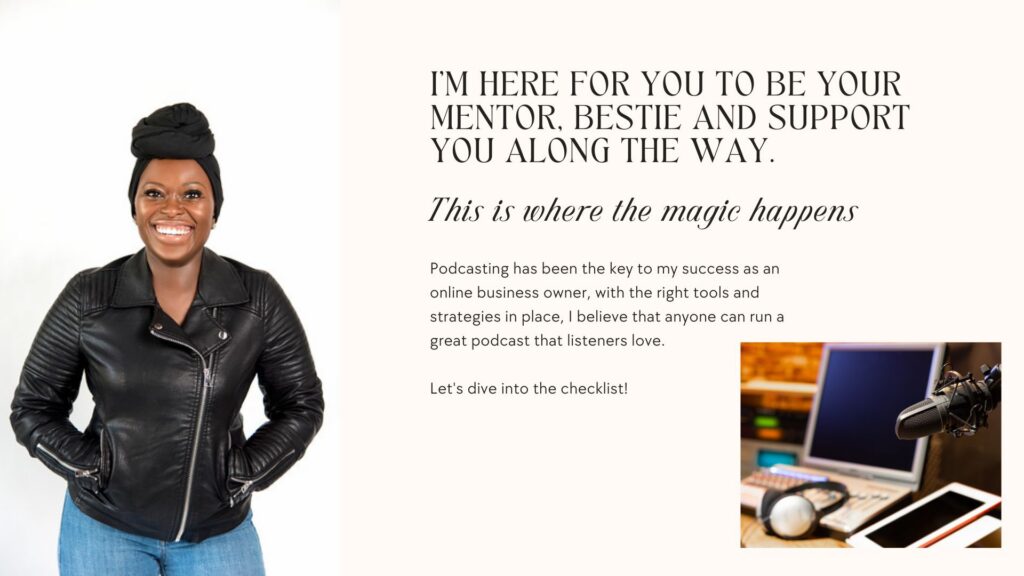
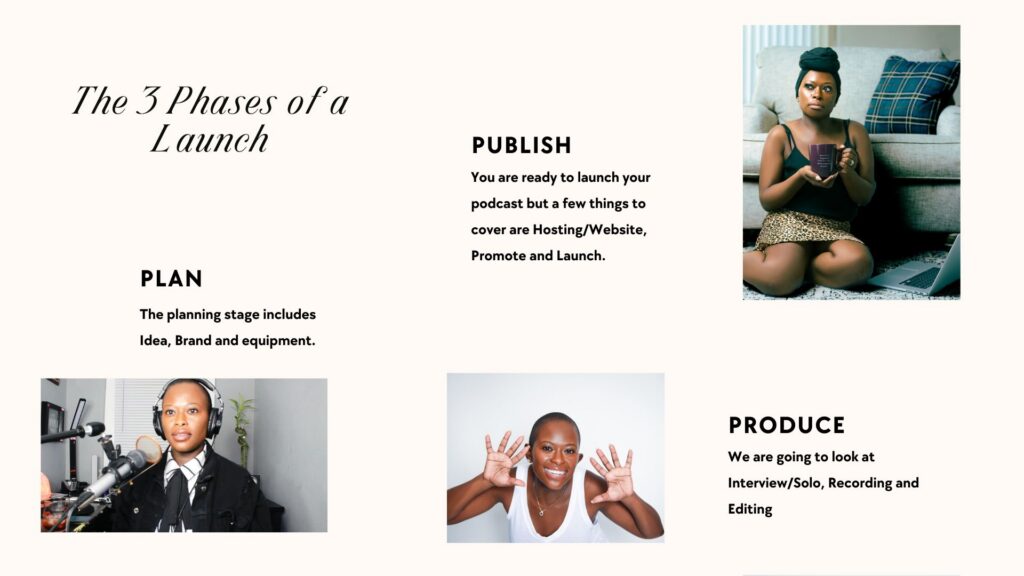
Grab the checklist featured above → Free checklist
Or see all free resources → Free Resources
The Five Pillars, Mapped to the 90 Days
Recognize — Week 1
Before you can build a platform out of your expertise, you have to actually see it as platform-worthy — and that’s harder than it sounds for a lot of accomplished women. The 4-Hour Live Intensive in week one is where Recognize happens in real time. Building your show concept, your story framework, and your first revenue map all force the same underlying question: what do you actually know, and why does it matter to someone else? Most women walk in undervaluing the answer. They walk out of that single day having recognized, often for the first time out loud, that their career expertise is the raw material for something real.
It’s worth naming why this happens on day one instead of being eased into over several weeks. Recognize is uncomfortable, and discomfort left unaddressed tends to get avoided rather than worked through. Front-loading it means the rest of the ninety days gets built on a foundation that’s already been named, rather than something everyone is still privately unsure of by week six.
Release — Weeks 2–3
Recognizing your expertise is one thing. Releasing the doubt, the old narrative, or the competing ideas about what your show “should” be is the next hurdle — and it’s exactly what weeks two and three are built around. Locking your concept and brand means letting go of every half-formed version of the show you’ve been carrying around, and committing to one clear direction. Your Mandatory 1:1 Strategy Session sits inside this window specifically because releasing that indecision is easier with someone else in the room helping you see what’s actually working versus what’s just familiar.
Release is often the pillar women underestimate walking in. It sounds like the easy one compared to Rebuild’s visible workload, but letting go of a version of your show you’ve been quietly attached to — sometimes for months or years — takes real effort. Locking the brand by the end of week three isn’t just a scheduling milestone. It’s the moment the indecision actually ends.
Rebuild — Weeks 4–6
This is where the show gets physically built — recording episodes, creating cover art, writing show notes, assembling the pieces that turn a concept into something real. Rebuild is the most literal pillar of the five in this context: you are constructing the actual artifact. It’s also, not coincidentally, the stretch where the Group Mentorship Call lands at week six — because rebuilding anything, whether it’s a show or a sense of authority, is easier with a room of women doing the same hard, unglamorous work alongside you.
This is also usually the hardest three weeks of the ninety, even though it doesn’t look that way from the outside. Recording your own voice and putting your name on something public tends to surface exactly the fear Recognize and Release were meant to address — which is why those two pillars come first. Rebuild without them tends to produce a show that gets recorded but never published.
Reframe — Weeks 7–10
With episodes recorded, the work shifts to positioning — how the show gets described, categorized, and presented to the world. Reframe is the pillar about language and perspective, and that’s precisely what these four weeks are doing at the show level: taking something that exists and shaping how it’s understood. A show description isn’t just SEO copy. It’s a reframe of your expertise into language a stranger can immediately grasp and want more of.
Revenue — Weeks 11–12
The final pillar is the one the whole methodology is named for, and it shows up at exactly the point you’d expect — launch. The visibility activation plan, the platform feature every client receives, the Podcast to Revenue Roadmap inside the vault: all of it exists to make sure Revenue isn’t an afterthought tacked onto the end, but the direct, planned result of everything recognized, released, rebuilt, and reframed in the ten weeks before it.
This is also the pillar most likely to be misunderstood if you look at it in isolation. Revenue in T2P was never only about money — it’s about the tangible return on the internal work done in the first four pillars. In FastTrack’s case, that return happens to be a launched show with a real monetization map attached to it. But the deeper point of the pillar holds regardless of platform: what you build, once you’ve genuinely recognized, released, rebuilt, and reframed, is meant to generate something back.
Why the Order Isn’t Arbitrary
I get asked sometimes why FastTrack doesn’t start with something more “exciting” — recording, branding, the parts that feel like actual podcasting. The answer is that skipping Recognize and Release and jumping straight to production is exactly how most independently launched podcasts stall. Women record episodes around expertise they haven’t fully claimed yet, or around a concept they’re still quietly unsure of, and the show reflects that uncertainty even when the audio quality is perfect. The five pillars are sequenced the way they are because each one is load-bearing for the one that follows. You can’t reframe positioning you haven’t rebuilt. You can’t rebuild a show around expertise you haven’t released the doubt about. You can’t release doubt about something you haven’t first recognized as valuable.
FastTrack works, when it works, because it doesn’t skip steps in service of speed. Ninety days feels fast from the outside. From the inside, it’s the minimum runway needed to move through all five pillars honestly rather than rushing past the internal ones to get to the parts that look good on a launch graphic.
I’ve watched what happens when women try to compress this order on their own — starting a show, hitting a wall around episode five or six, and quietly letting it go. Almost every time, the wall isn’t technical. It’s an unresolved Recognize or Release question that never got addressed before recording started. The order isn’t a preference of mine. It’s the sequence I’ve watched actually hold up against the alternative.
What This Means If You’re Considering FastTrack
If you’ve read the T2P explainer content and it resonated, FastTrack is what it looks like to actually live inside that methodology for three months with structure and support, rather than reading about it and nodding along. The pillars aren’t a metaphor laid over the curriculum after the fact — they were the design document before the curriculum existed. Recognize became week one. Release became weeks two and three. And so on, in the order that actually works, not the order that feels most exciting to market.
If you’re earlier in your own T2P journey — still in Recognize, or still working through Release around your own story — that’s worth being honest about before applying. FastTrack assumes you’re ready to move through all five pillars inside a fixed 90-day window. If you’re not there yet, the T2P content itself, or a 1:1 Clarity Consultation, is a better next step than the accelerator.
There’s no penalty for being honest about that timing, and there’s no version of this where starting FastTrack before you’re ready helps you get there faster. The methodology works because the order is respected, not rushed — the same is true of deciding when you personally are ready to step into it.
Key Takeaways
✓ FastTrack is the Trauma-to-Profit™ Methodology applied specifically to a 90-day podcast launch — not a separate framework running alongside it.
✓ Each of the five pillars maps directly onto a phase of the program: Recognize (Week 1), Release (Weeks 2–3), Rebuild (Weeks 4–6), Reframe (Weeks 7–10), Revenue (Weeks 11–12).
✓ The pillar order isn’t arbitrary — each stage is load-bearing for the one that follows, which is why FastTrack doesn’t jump straight to recording or branding.
✓ If T2P content resonates with you, FastTrack is what it looks like to live inside that methodology with real structure, rather than reading about it.
✓ Being honest about where you are in your own Recognize/Release journey matters before applying — FastTrack assumes readiness to move through all five pillars in a fixed window.
Go Deeper on the Methodology or the Program
→ Explore the Full Trauma-to-Profit™ Methodology
→ What Actually Happens Inside a 90-Day Podcast Launch Accelerator: 90-Day Podcast Launch: What to Expect
→ Application-Only: Why FastTrack Isn’t for Everyone: Why FastTrack’s Application Process Matters
Ready to Apply the Methodology to Your Own Platform
The resources below are exclusively for women who want to launch or grow a podcast as a real income stream.
→ Not Sure Yet? Book a 1:1 Clarity Consultation
→ Get the eBook: Find Your Voice: The Woman Behind the Mic
→ Browse More Business & FastTrack Articles
Be Yourself. Voice Yourself. Love Yourself.
Sherley’s Show is learning and growing every single day. We aim to uplift all marginalized voices both on this podcast and in real life. Please note that we are always striving to change the problematic language that society has internalized in us. Thank you for your patience as we aim to strip certain phrases from our vocabulary.
Would you like to be a guest
Are you interested in getting your opinion out about a particular topic but don’t know how to do so? If so, here is an opportunity to do so to share your point of view, PLUS get your message and voice out there. It is always a great way to know about different perspectives and enrich ourselves through knowledge sharing.
Submit your relationship question.
Sherley’s Show provides an atmosphere where every woman is comfortable growing into their best self. Sherley’s Show is a no judgment podcast where we discuss how to rise strong out of all types of obstacles that come with relationships. Through personal life experiences and discussions ranging from infidelity, trust, forgiveness, sex, heartbreak, self love, therapy and more, we offer words of empowerment as you strive to build and maintain all of the relationships in your life. You may be going through something that is unique and difficult. Sharing your story gives others comfort and could also be helping someone else. Let them know they are not alone. Everyone has a story, do not let fear hold you back.
Disclosure: This post contains affiliate links, I will get a commission if you decide to make a purchase through any of my links, at no cost to you. Please read my disclosure for more info.

Want to launch a podcast?
FRee Resource!
Download Sherley’s FREE Bootcamp Podcast Launch Checklist! The no-fluff, step-by-step roadmap for busy women ready to finally launch the podcast they’ve been dreaming about.
At Sherley's Show, we believe that when women feel seen and supported, anything is possible. Whether you're tuning in for inspiration, education, or community—you belong here.



next

say goodbye to being the side chick
When you find yourself really settling with the reality that you are the side chick, when you find yourself tired of the games and/or the complacency, it’s time to ask yourself a few questions.
next

why is therapy important?
Solo therapy, partnered therapy, or group therapy... what exactly are the benefits? If you’re still on the fence about whether or not you should go and if therapy can really do anything for you... this post is for you.
next
CONNECT
elsewhere:

STAY AWHILE AND READ
THE BLOG

BINGE
THE PODCAST
The place where we chat about obstacles that come out of relationships and how to rise up from them. Self-love, marriage, infidelity, sex, heartbreak, and more.

HANG OUT ON

Comments +