
Navigating Realistic Marriage Expectations




Why I Let Myself Think Realistically About My Marriage, Even After 29 Years
This content is shared for storytelling, educational, and entertainment purposes only and is not a substitute for professional counseling or therapy.
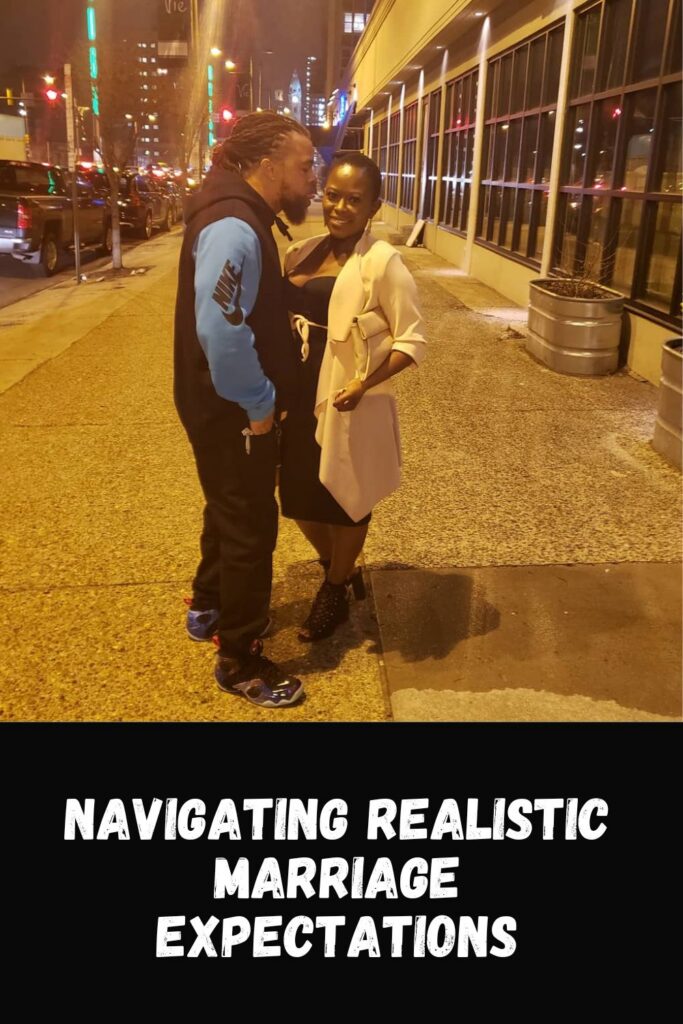
I love my husband. Twenty-nine years in, that has never once been the question. But I have to be honest about something else, too: I am also one of the most realistic people I know when it comes to my own marriage. I think about the future. I think about change. I let myself sit with the possibility that Kalief and I may not walk every single year of this life side by side. And no, I am not talking about death, or an accident, or something outside of our control. I am talking about the quieter, harder possibility. People evolve, and evolution does not always move in the same direction.
Kalief does not love it when I talk like this. He tells me I am speaking things into existence, and honestly, that question hits me every time. Am I manifesting a bad outcome, or am I just being honest as hell about how relationships actually work? That is exactly what I want to dig into today.
The Fairy Tale Nobody Warned Us About
I grew up on Cinderella. Beauty and the Beast. The prince who shows up, the happily ever after that rolls the credits before anyone has to do the actual work. And like a lot of little girls, I absorbed that story as a blueprint, not a fantasy. I genuinely believed that was what a relationship was supposed to look like, that love was the finish line, not the starting point.
Nobody sits little girls down and says, this is going to be hard sometimes, and hard is not the same as broken. We are not taught how to “relationship.” What we get instead is nature and nurture doing their quiet work in the background: watching our parents, absorbing what the world around us modeled, picking up scraps of wisdom from whichever family member or friend happened to be honest enough to talk about it. That is the entire curriculum. There is no class. There is no manual. You are handed a fairy tale and a front row seat to your parents’ marriage, and somehow that is supposed to prepare you for one of the hardest, longest commitments of your life.
If I could go back twenty-nine years and hand my fifteen-year-old self a different lens, I would. Things would look drastically different. I tell Kalief this all the time, half-joking, half-serious: if he met the woman I am today, I honestly do not know if we would end up together. We met at fifteen and sixteen years old. We are now forty-three and forty-four. We did not enter this relationship as two fully formed adults who chose each other with clear eyes. We grew up together, and we had to figure it all out in real time, with no roadmap, making it up as we went.
Nobody Handed Us a Manual, So We Figured It Out the Hard Way
Kalief and I did not walk into a therapist’s office until we were in our thirties. That is a damn long time to navigate a relationship on instinct alone. And I do not say that with shame. I say it because it is the truth, and I think a lot of women reading this recognize the same gap in their own story.
Therapy is not something our society encourages, and it is especially true in the Black community. Research backs up what so many of us already feel in our bones: only about a quarter of Black adults who need mental health treatment ever seek it out, compared to roughly forty percent of white adults.
That gap is not about caring less. It is about culture, stigma, and generations of being told to handle it yourself, keep it in the family, keep it moving. But looking back, there is so much Kalief and I would have done differently if we had walked into that room ten or fifteen years sooner. If you have not read it yet, I go deeper into what that season looked like for us in How to Make a Relationship Work Even After a Heartbreak, where I talk about the year sixteen and seventeen mark of our marriage, the season that almost broke us, and the work that put us back together.
“Are You Speaking It Into Existence?”
This is the pushback I get most from Kalief. When I say things like, “I wonder who we’ll each be at fifty,” or “I don’t know if the version of me ten years from now is guaranteed to want the same things,” he hears manifestation. He hears me opening a door I should be keeping shut.
But here is where I land, every single time: there is a real difference between speaking something into existence and simply refusing to pretend it is impossible. I am not out here predicting doom. I am not hoping for an ending. Shit, if anything, it is the opposite. What I am doing is acknowledging a truth that most couples avoid saying out loud: we are not the same people we were a year ago, five years ago, ten years ago, and we will not be the same people a year, five years, or ten years from now. That is not pessimism. That is just how human beings work.
| Asking “what if things change” does not mean you are hoping they will. It means you respect your relationship enough to stay honest with it. |
I actually unpacked this exact tension, the space between honesty and self-fulfilling fear, in a companion post called Navigating Long-Term Relationships: The ‘What If’ Dilemma, where I got even more specific about the actual questions I have sat with over the years. If you have never let yourself ask “what if,” I would encourage you to start there.
The Smooth, Plain Field Trap
Here is what I think keeps most couples from ever having this conversation: in the beginning of a relationship, we work overtime to keep things smooth. Uneventful. We avoid anything that might introduce friction, because friction feels like a threat to something we just found and do not want to lose. So we skip the uncomfortable conversations. We save them for later. Sometimes we save them so long that later never actually comes.
That instinct is understandable, but it is also one of the most common ways couples set themselves up for a harder road down the line. The uncomfortable conversations, the ones about money, about values, about what happens if one of us changes in a way the other did not sign up for, those need to start early. Not after the wedding, not after the tenth anniversary, not after the first real crisis forces the conversation on you like a damn ambush.
I wrote about this same idea from a slightly different angle in Common-Sense Love: Balancing Trust and Reality in Relationships, and it connects directly to what I explored in Why Communication About Sex Matters Before Marriage, because the pattern is the same. Whatever topic feels too risky to bring up early is usually exactly the topic that needs to be brought up early.
Why Bringing This Up Feels So Scary, And Why That’s Normal
If you have ever tried to say to your partner, “what if we’re not together in five years,” you already know the reaction it usually gets. Wait, what? Why are you thinking about that? Are you trying to leave me? The question alone feels like an accusation, even when it is nothing more than an honest thought passing through your mind.
It goes right along with the way most of us treat the topic of death. We know, logically, that none of us are here forever. And yet very few people can sit in a comfortable, open conversation about it. Relationships work the same way. We know, logically, that people grow and change. We know that couples do drift, that values do shift, that the person you married is not frozen in time. And yet bringing that reality into the light still feels forbidden.
I think the discomfort itself is worth paying attention to, not avoiding. Relationship researchers at the Gottman Institute, who have studied thousands of couples over several decades, have found that the happiest long-term couples are the ones who let go of rigid expectations and adapt to who their partner is becoming, rather than clinging to who their partner used to be. Letting go of an old picture of your relationship is not failure. It is often exactly what keeps a long relationship alive.
The Questions Worth Asking Early
If I could change the trajectory of how I approached relationships twenty-nine years ago, this is where I would start. Not with fear. Not with suspicion. Just with honesty.
- Have we talked about who we each want to become in five, ten, twenty years, not just who we are right now?
- Do we know how to talk about change without treating it like betrayal?
- Have we normalized therapy, or individual and couples counseling, as a tool, not a last resort?
- Can we sit in an uncomfortable conversation without one of us shutting it down to protect the peace?
- Do we check in with each other regularly, or only when something has already gone wrong?
None of these questions are meant to put you in a place of doubting your partner. This is not about looking at the person across from you and wondering if today is the day it all falls apart. It is about letting the relationship flow naturally, while still being honest enough with yourself and with your partner to say, I see you changing, and I want us to grow in a direction we choose together, not one we stumble into by accident.
I explored a related side of this in Why Love Requires Hard Work: Breaking the Myths, and if you are trying to figure out where your own relationship stands right now, How To Know If The Relationship Is Over is another honest read worth sitting with.
Twenty-Nine Years In, Here Is What I Actually Believe
I am not writing this because I think Kalief and I are headed anywhere but forward, together. We have already survived a seventeen-year mark that could have ended us. We made it through betrayal, through my own infidelity, through the kind of rupture that breaks a lot of couples permanently. We rebuilt. That story matters, and it is real.
But surviving one chapter does not exempt you from being honest about the next one. The version of me at forty-three is not the same woman who said yes all those years ago, and the version of me at fifty will not be identical to who I am today. Kalief is evolving too. And the real question I keep coming back to is not “will we make it,” but “can we keep choosing each other as we both keep changing.” That is a very different question, and I think it is the one more couples need to be asking.
Key Takeaways
- Thinking realistically about your relationship’s future is not the same as manifesting its ending, it is a form of honesty most couples never practice.
- We are never formally taught how to “do” a relationship. What shapes us is what we watched growing up, combined with the fairy tales we absorbed before we knew better.
- The uncomfortable conversations, about change, values, money, and growth, belong at the beginning of a relationship, not years down the line.
- Therapy is still stigmatized, especially in the Black community, but normalizing it early can change the entire trajectory of a long-term relationship.
- People evolve. A relationship that can hold space for that evolution, instead of pretending it will not happen, is a relationship built to actually last.
Listen to More on Sherley’s Show
This post is the spin-off companion to a deeper conversation happening across Sherley’s Show. There are three ways to hear more on this topic:
- Real Talk Series, Kalief and I sit down together and talk through the realities of a nearly thirty-year relationship, unfiltered, from both sides.
- Conversations, Sherley and Kira go deep on infidelity, heartbreak, and what it actually takes to rebuild after crisis.
- Interviews, guest experts and everyday women share their own perspective on love, growth, and long-term relationships.
You can catch all three formats on the Sherley’s Show podcast page, and if this resonated with you, share it with a woman in your life who needs permission to think, and speak, realistically about her own relationship.
We are rooting for you. We always are.
Sherley’s Show is learning and growing every single day. We aim to uplift all marginalized voices both on this podcast and in real life. Please note that we are always striving to change the problematic language that society has internalized in us. Thank you for your patience as we aim to strip certain phrases from our vocabulary.
Would you like to be a guest
Are you interested in getting your opinion out about a particular topic but don’t know how to do so? If so, here is an opportunity to do so to share your point of view, PLUS get your message and voice out there. It is always a great way to know about different perspectives and enrich ourselves through knowledge sharing.
Submit your relationship question.
Sherley’s Show provides an atmosphere where every woman is comfortable growing into their best self. Sherley’s Show is a no judgment podcast where we discuss how to rise strong out of all types of obstacles that come with relationships. Through personal life experiences and discussions ranging from infidelity, trust, forgiveness, sex, heartbreak, self love, therapy and more, we offer words of empowerment as you strive to build and maintain all of the relationships in your life. You may be going through something that is unique and difficult. Sharing your story gives others comfort and could also be helping someone else. Let them know they are not alone. Everyone has a story, do not let fear hold you back.
Disclosure: This post contains affiliate links, I will get a commission if you decide to make a purchase through any of my links, at no cost to you. Please read my disclosure for more info.

Want to launch a podcast?
FRee Resource!
Download Sherley’s FREE Bootcamp Podcast Launch Checklist! The no-fluff, step-by-step roadmap for busy women ready to finally launch the podcast they’ve been dreaming about.
At Sherley's Show, we believe that when women feel seen and supported, anything is possible. Whether you're tuning in for inspiration, education, or community—you belong here.



next

say goodbye to being the side chick
When you find yourself really settling with the reality that you are the side chick, when you find yourself tired of the games and/or the complacency, it’s time to ask yourself a few questions.
next

why is therapy important?
Solo therapy, partnered therapy, or group therapy... what exactly are the benefits? If you’re still on the fence about whether or not you should go and if therapy can really do anything for you... this post is for you.
next
CONNECT
elsewhere:
STAY AWHILE AND READ
THE BLOG

BINGE
THE PODCAST
The place where we chat about obstacles that come out of relationships and how to rise up from them. Self-love, marriage, infidelity, sex, heartbreak, and more.

HANG OUT ON

Comments +