
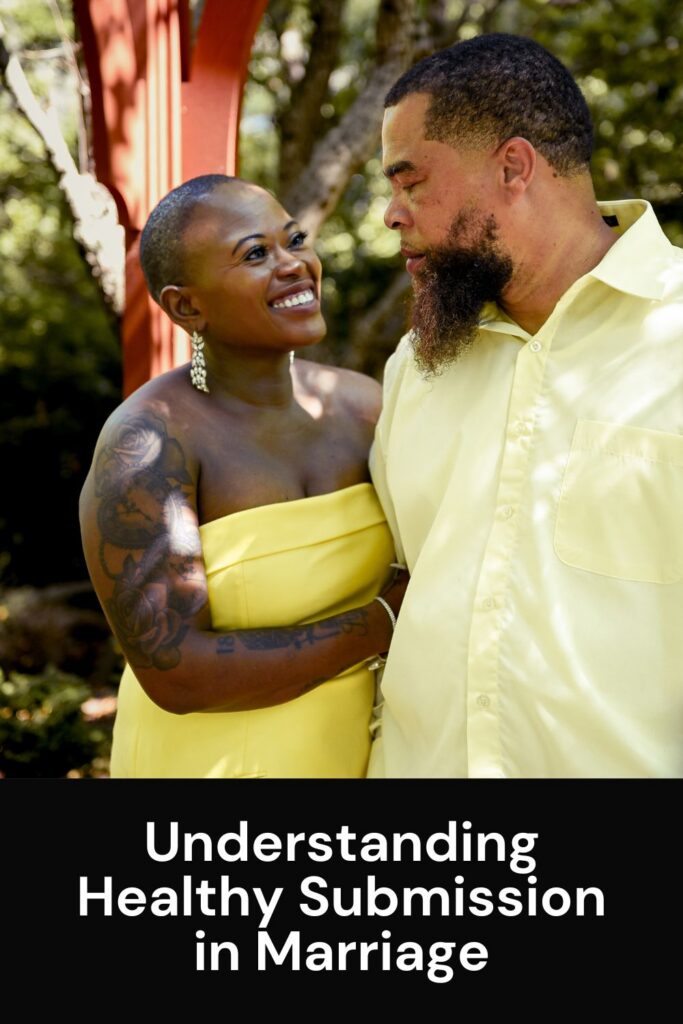
Understanding Healthy Submission in Marriage




Submissive Wife: Why the Word Isn’t Negative — and What Healthy Submission Looks Like
This content is shared for storytelling, educational, and entertainment purposes only and is not a substitute for professional counseling or therapy.
To hear our conversation in real time, listen to the full episode below. Make sure you tune into the show. You’ll get all the raw, unfiltered moments and deeper insights.
Podcast Blog post: The Role of Leadership and Submission in Healthy Relationships
A Real Talk Series conversation between Sherley and her husband, Kalief
Am I a good listener? Honestly? Not in the way most people mean it. I hear every single word you say. But I am not going to fire back at you the second you stop talking. I am going to sit with it, turn it over, give it real thought, and then come back to the table. Because you do not want to act off a reaction. When you react, you never give yourself the room to actually take action.
That little back-and-forth between me and my husband, Kalief, is exactly where this conversation started. We have been together for nearly 28 years now. We have walked through real trauma, real joy, and a whole lot of learning in between. So when we sat down for this Real Talk Series episode to talk about submission, we did not come at it from some polished, picture-perfect place. We came at it from lived experience.
And I want to say this up front: everything here is personal reflection. I am sharing from a place that is healed, not from an open wound. I am not a therapist, and none of this is clinical advice. It is two people who chose each other again and again telling you the truth about what we have learned.
What submission actually means to me
When people hear the word submissive, they flinch. It sounds small. It sounds like you are erasing yourself. But that is not what it means to me at all.
I will be honest about where my framing comes from. I do not have all my scripture memorized, but I went and read it for myself. Ephesians puts it this way: wives, submit to your own husbands as to the Lord, and husbands, love your wives as Christ loved the church and gave himself up for her. What stops me every time is the verse right before it, the one that asks everyone to submit to one another out of reverence for Christ.
That single line is actually one of the most debated verses in the whole conversation. Some scholars read “submit to one another” as mutual submission — the idea that a husband and wife both place themselves underneath each other, each one putting the other first. Others read it more traditionally, where the wife follows her husband’s loving leadership and his job is to love her sacrificially. I am not here to settle a theology debate. I am telling you that in my marriage, submission has never meant being less. It has meant trust inside an order we both respect.
There is healthy submission, and there is the other kind
Here is the part a lot of women miss. You can be submissive in an unhealthy way, and I know because I was.
When Kalief and I first got together, I was young and naive, and I will admit it — I basically worshiped the ground he walked on. My pedestal looked more like him than like God, and more like him than like myself. That is not devotion. That is a bad order. There was an innocence to it that he appreciated, sure, but I did not yet know what a healthy relationship even looked like.
I would describe myself now as a true alpha female. And I am all for the man being the leader in the home. But I want my man to lead in a healthy way — spiritually, emotionally, and physically, in how he treats his partner and his children. Because here is my one non-negotiable: I will step up if I feel like my man is leading us straight out to sea to drown. A wife being heard is not a wife being disrespectful.
A leader has to be a good listener
Being submissive does not mean you do not get to speak. A good leader wants his wife to voice herself. There is a difference between someone who leads a team and someone who just bosses a team around. Nobody respects the boss who will not get their hands dirty or who is a hypocrite in their own words. The same rule applies at home.
And this is not just my opinion — the research backs it. Relationship researcher Dr. John Gottman studied newlywed couples for years and found something that surprised even him: the men who let their wives influence them ended up in the happiest, most stable marriages. The ones who refused to share power were far more likely to see the marriage fall apart. His decades of work found that wives, even in shaky marriages, were already good at accepting influence. It was the husbands who often were not.
Sit with that. The science of lasting marriage and the heart of healthy submission are pointing at the same thing: leadership and listening are not opposites. A man who truly leads makes room for his wife’s voice and still makes sound decisions. That is the leader a woman has no problem standing behind.
“Don’t give me lip” — what Kalief means, and what he doesn’t
Now let me bring my husband into this, because his version sounds very different from mine at first. Ask Kalief what a submissive wife is and he will say, only half joking: keep the house good, keep food on the table, make sure the kids are good, and do not give him lip.
When a woman hears “don’t give me lip,” every wall goes up. So we broke it down on the episode. What he means is that a man carries a lot outside the house, and he does not want to walk through the door into constant complaining. What he does not mean — once we actually talked it through — is that I cannot tell him something that matters.
Here is my pushback, and it is the heart of the whole episode. There is a difference between nagging and respectfully telling your partner something real. If I say, “Babe, can you please get your shoes out of the living room,” that is not lip. That is a request. (He once got upset that I put his boots on the front porch because he did not want them to be cold. So you tell me who is really giving lip in this house.) The point is this: submission cannot become a rule that says a woman is not allowed to speak. The home is a collective effort. I work, I run a podcast, I am gone two or three days a week, and I am raising our two children right alongside him. “You handle inside, I handle outside” only works when “inside” is a partnership and not a one-woman job.
Submission is not slavery
Let me make this plain, because it matters. A submissive wife is not a slave to her family. Even Kalief agrees with that. Submission is something I offer to my partner inside a committed, romantic relationship — not to the household as a list of chores, and not to the children. I am their mother, not their servant, and I am not in a romantic relationship with my kids. The respect flows toward the person I have chosen to do life with.
Respond, don’t react
Remember how this whole thing started — with Kalief saying he will not respond to me right away? It sounds like avoidance. It is actually one of the healthiest things he does. As he put it: you do not want to act off a reaction, because then you never give yourself the room to take action.
There is real brain science under that. Psychologist Daniel Goleman coined the term “amygdala hijack” to describe those moments when a fast, intense emotion bypasses your thinking brain and you snap, shut down, or fire off something you regret. The fix experts point to is almost embarrassingly simple: pause before you respond. Even a few seconds gives your rational mind time to catch up so you respond on purpose instead of reacting on instinct.
In a marriage that has survived hard seasons, that pause is everything. The average person meets anger with anger. The couple that lasts learns to take a breath, take a day if they need it, and come back to the table once the heat has cooled.
Why so many women are scared to submit
If submission can be this healthy, why do so many women hear the word and immediately put up a wall? Kalief and I went back and forth on this one, and we landed in two places.
It often starts in childhood
Kalief believes a lot of it traces back to how a woman was raised, and I agree that upbringing plants the seeds. Kids do not get taught what a relationship looks like — they watch it. But I will add my own truth: even a two-parent home can be quietly toxic. I grew up with both my parents present, and I still rarely saw real affection between them. That shaped me too. So no, I do not use my childhood as a crutch for poor decisions as a grown woman — but I do not pretend it left me untouched either. (We go deeper on this in our conversation about breaking family cycles.)
And too many men are not leading well
Here is my honest, slightly sharp take: a lot of women are not afraid of submission. They are afraid of who they would be submitting to. When a man is not clear, when it is really just about sex, when he will not say what he actually wants — a woman has no idea what she is even being asked to follow. If sex is all you want, say that and stop wasting her time. Courtship should be moving toward something. Women have a hard time submitting because too many men are not presenting themselves as someone worth trusting with the lead.
Bringing something to the table — both of you
Social media will tell women a man has to pay every single bill or he gets kicked to the curb. Be real: if a woman out-earns her partner, that math does not work, and it does not make him worthless. I have also heard the flip side — that a woman does not need to bring anything to the table, she just needs to be present. I do not buy that either.
To me, the table is a shared one. That is exactly why I am so big on having the real conversations early — about money, faith, intimacy, all of it — before you ever talk about who leads and who submits. (We mapped a lot of those questions out in Common-Sense Love.) My own honesty here: money was a primary goal for me when I was young, but I did not chase a rich man. I chose a real one. And I carried damage in too — my mother often made my father seem worthless, like nothing he brought mattered, and I dragged that into my marriage. Naming it was part of healing it.
Submission has four lanes: spiritual, emotional, financial, physical
Here is the framework I keep coming back to. When a woman submits, she is really asking: what am I submitting to? You cannot answer that until you look at four areas:
- Spiritual — What do you believe? Who or what leads you? A lot of women want a man who believes in something bigger than himself.
- Emotional — Can you actually listen, hold space, and respond instead of react?
- Financial — What is the real setup, and is it honest? Sometimes the man carries it; sometimes the woman steps up. Either way, talk about it.
- Physical — How do you handle attraction, intimacy, and the way you treat each other day to day?
A woman needs to trust that you are leading all four lanes in a healthy way. If you are not, you will run into issues — not because she is rebellious, but because nobody can follow a leader who is all over the place.
What we owe the next generation
We have a son and a daughter, and this part hits home. When I ask our daughter what she wants in a relationship, she gives me a bland answer like, “I want them to treat me good.” What does that even mean when the tide gets rough? She does not know yet, and that is not a knock on her — it is the whole point.
Kids do not arrive knowing what they want. Relationships are not taught in school. They are absorbed from what young people see at home and on a screen. So if we want our kids to recognize healthy leadership and healthy submission one day, we have to model it, talk about it, and stop pretending the hard stuff away. The delivery matters too: tell a kid “that person is not for you” and watch them run straight toward that person. Better to raise them to know their own standards than to try to control their choices.
The hardest part: submission after betrayal
I get asked this a lot: “Why would you submit to a man who cheated on you?” And honestly, Kalief gets the same question in reverse, because the truth is we have both been the one who broke trust and the one whose trust was broken. So here is my real answer.
- Two wrongs do not make a right. I was not a saint in this story either, and pretending otherwise would have been a lie.
- I am an over-thinker, so I processed everything — short-term and long-term. I even put myself in hypothetical situations: single, or with someone else. Those scenarios mattered.
- I had to consider my family. By then we had two children. The decision was never only about me and Kalief.
- I had to be honest about whether he was truly remorseful and how much effort he was willing to put in. We went to counseling. Rebuilding trust after it is destroyed takes a tremendous amount of work.
In a nutshell, we are still together not only because I love him, but because he is genuinely my person, and even through the lowest points I still saw light at the end of the tunnel for us. And I want to be clear — I felt everything. There were moments I wanted to hurt him. But I refused to make a permanent decision from a temporary emotional state. Anger, grief, sadness, even moments of happiness — I let all of it move through me, and then I made my choice from sound judgment, not from the storm. If betrayal is your reality right now, please know there is no shame in leaning on a counselor or trusted support as you sort through it; you should not have to carry that processing alone. We unpack the messy, layered truth of this in Healing After Infidelity and Infidelity: The Hidden Layer of Accountability.
Leading is not the same as controlling
A friend of mine once dated a man who finally took charge and made sure she was good. She had always been the leader in past relationships, so she did not know how to sit in the passenger seat. I told her to let him drive, and to speak up the moment something felt wrong. She tried — until she could not anymore, because his “leadership” was really possessiveness and control.
That is the line. A leader does not micromanage and dominate. He plays to strengths. In our house, Kalief tells me what the bills come to and I handle paying them — that is teamwork, not control. And it goes both ways: when I wanted to jump into a certain opportunity, he told me to slow down, and it turned out to be a scam. I could have spun that into “he’s trying to control me.” Instead I took it as him protecting us. The difference between leading and controlling is whether the other person ends up bigger or smaller for being with you.
The bottom line
Leadership and submission are not dirty words. Done with mutual respect, they are some of the most beautiful things in a relationship. But a woman deserves to know exactly what she is submitting to. I am not going to hand over my trust to a man who is nowhere near a level playing field, all over the place, or unwilling to lead the four lanes well.
So to the men: make it clear. Show her who you are spiritually, emotionally, financially, and physically. Because here is the secret — no matter how independent, how outspoken, how alpha a woman may be, she will listen to a good man who actually knows what he is talking about. Women do not have a problem submitting. We have a problem submitting to weak leadership.
As for me, my order finally sits right: God, myself, my husband, then our children — not because the kids matter less, but because one day they will build families of their own, and it will come right back to the two of us. Be yourself. Voice yourself. Love yourself. All three can live inside one strong, submitted, deeply loved woman at the same time.
Key takeaways
- Submission is not negative and it is not self-erasing. Healthy submission is trust you offer inside a relationship built on mutual respect.
- A real leader listens. Research and 28 years of lived experience agree — a man who makes room for his wife’s voice builds a stronger marriage.
- Submission is not slavery and it is not silence. A wife can speak up, hold her standards, and still honor her partner.
- Respond, do not react. Pausing before you answer protects the relationship more than winning the moment.
- Women are not afraid of submission. They are afraid of submitting to weak or unclear leadership.
- Submission lives in four lanes — spiritual, emotional, financial, and physical. A woman deserves clarity in all four before she follows anyone’s lead.
- Leading builds your partner up; controlling shrinks them. If submission makes you smaller, that is not leadership.
Your next step
If this stirred something in you, do not let it just sit there. Here is how to take it further:
- Press play. Hear Kalief and me say all of this in our own voices — jokes, bloopers, sharp edges and all — on the Real Talk Series.
- Go deeper. Wondering how two people make it nearly three decades? Start with Celebrating and Surviving 25 Years Together, or sit with the harder question in How To Know If The Relationship Is Over.
- Reflect with your person. Ask each other the real questions — about faith, money, intimacy, and how you each want to lead and be led.
- Stay in the room. Rate, subscribe, and follow along so you never miss an episode — and so we can keep having the honest conversations most people are afraid to have.
Frequently asked questions
Is being a submissive wife a bad thing?
No. The word sounds negative, but healthy submission is not about losing yourself. It is offering trust to a partner who leads with respect and listens to you. It becomes unhealthy only when a woman is silenced or treated as a servant rather than a partner.
What does submission in marriage actually mean?
It means trust and respect inside an order both people agree to — not obedience, and not slavery. A wife being submissive still speaks up, still has standards, and still helps lead in her areas of strength. A good leader makes room for her voice.
Can a strong, independent woman still be submissive?
Yes. Independence and submission are not opposites. A confident woman will gladly follow a man who leads well spiritually, emotionally, financially, and physically. The issue is rarely the woman’s strength — it is whether the leadership is trustworthy.
Why are so many women afraid to submit?
Two big reasons: how they were raised, since relationships are learned by watching, and weak or unclear leadership from men. When a man will not say what he wants or leads in an unhealthy way, a woman has no clear, safe thing to submit to.
What is the difference between a husband leading and controlling?
Leading plays to each partner’s strengths and leaves the other person feeling bigger and safer. Controlling micromanages, dominates, and isolates, leaving the other person feeling smaller. If submission makes you shrink, that is not leadership.
Sources & further reading (external research)
- Gottman — husbands accepting influence predicts marriage success (University of Washington): washington.edu
- The Gottman Institute — overview of marriage and couples research: gottman.com
- Ephesians 5:21 as mutual submission (egalitarian view), CBE International: cbeinternational.org
- Ephesians 5 and headship (complementarian view), CBMW: cbmw.org
- Amygdala hijack and pausing before reacting (term coined by Daniel Goleman), Simply Psychology: simplypsychology.org
Related on Sherley’s Show (internal links — verified live)
- Real Talk Series (all episodes)
- Healing After Infidelity: Consequences and Forgiveness
- Infidelity: The Hidden Layer of Accountability
- Breaking Family Cycles: A Path to Emotional Healing
- Common-Sense Love: Balancing Trust and Reality in Relationships
- Advice Time Series Premiere: Celebrating and Surviving 25 Years Together
- How To Know If The Relationship Is Over
Sherley’s Show is learning and growing every single day. We aim to uplift all marginalized voices both on this podcast and in real life. Please note that we are always striving to change the problematic language that society has internalized in us. Thank you for your patience as we aim to strip certain phrases from our vocabulary.
Would you like to be a guest
Are you interested in getting your opinion out about a particular topic but don’t know how to do so? If so, here is an opportunity to do so to share your point of view, PLUS get your message and voice out there. It is always a great way to know about different perspectives and enrich ourselves through knowledge sharing.
Submit your relationship question.
Sherley’s Show provides an atmosphere where every woman is comfortable growing into their best self. Sherley’s Show is a no judgment podcast where we discuss how to rise strong out of all types of obstacles that come with relationships. Through personal life experiences and discussions ranging from infidelity, trust, forgiveness, sex, heartbreak, self love, therapy and more, we offer words of empowerment as you strive to build and maintain all of the relationships in your life. You may be going through something that is unique and difficult. Sharing your story gives others comfort and could also be helping someone else. Let them know they are not alone. Everyone has a story, do not let fear hold you back.
Disclosure: This post contains affiliate links, I will get a commission if you decide to make a purchase through any of my links, at no cost to you. Please read my disclosure for more info.

Want to launch a podcast?
FRee Resource!
Download Sherley’s FREE Bootcamp Podcast Launch Checklist! The no-fluff, step-by-step roadmap for busy women ready to finally launch the podcast they’ve been dreaming about.
At Sherley's Show, we believe that when women feel seen and supported, anything is possible. Whether you're tuning in for inspiration, education, or community—you belong here.



next

say goodbye to being the side chick
When you find yourself really settling with the reality that you are the side chick, when you find yourself tired of the games and/or the complacency, it’s time to ask yourself a few questions.
next

why is therapy important?
Solo therapy, partnered therapy, or group therapy... what exactly are the benefits? If you’re still on the fence about whether or not you should go and if therapy can really do anything for you... this post is for you.
next
CONNECT
elsewhere:

STAY AWHILE AND READ
THE BLOG

BINGE
THE PODCAST
The place where we chat about obstacles that come out of relationships and how to rise up from them. Self-love, marriage, infidelity, sex, heartbreak, and more.

HANG OUT ON

Comments +